
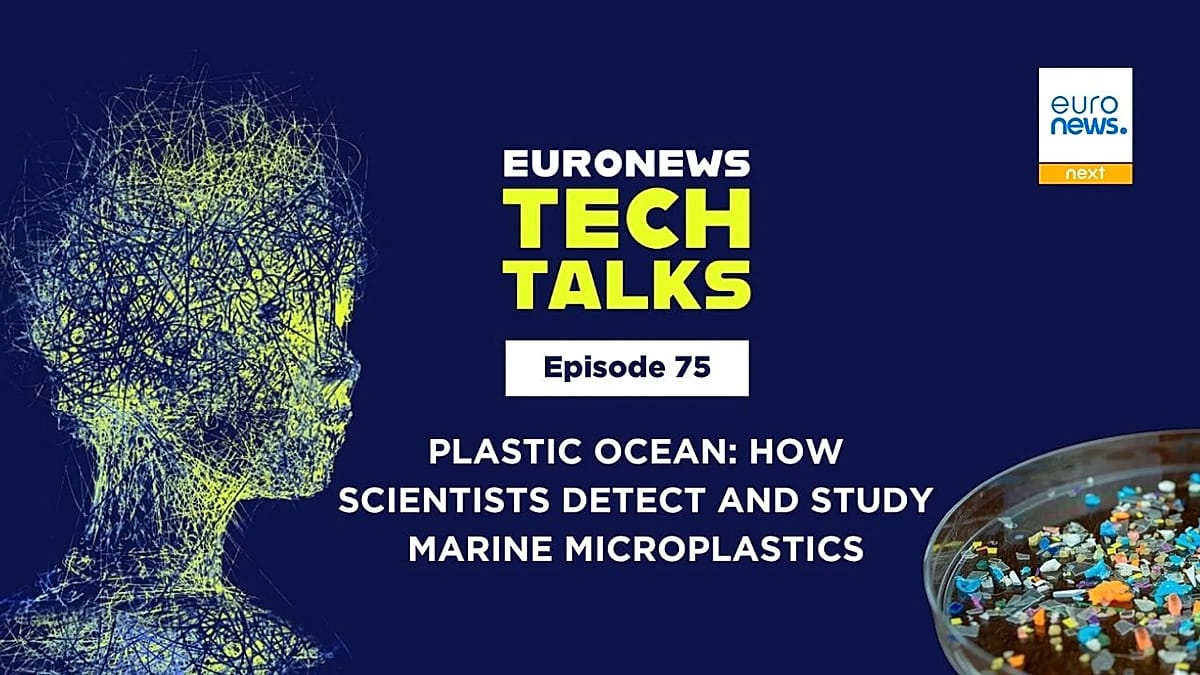
The ocean hides countless secrets that we can’t see from the shore—rare species, intricate ecosystems, but sadly, also heaps of trash. Each year, a staggering 52 million tonnes of plastic waste find their way into our seas, resulting in about 24 trillion microplastic particles floating around. These microplastics are tiny bits of plastic, measuring less than 5 millimeters, and they’re everywhere—from the deepest depths to the surface waters, wreaking havoc on ecosystems in ways that scientists are still trying to piece together. So, how do these microplastics end up in our oceans? What tech can help identify them? And just what are the consequences for marine life? Euronews Tech Talks recently visited the Flanders Marine Institute (VLIZ) in Ostend, Belgium, where a team led by researcher Ana Catarino is diving deep into the world of marine microplastics, gathering data right from the North Sea.
You see, plastics can hitch a ride to the ocean in various ways—think fishing nets that snag loose, or litter escaping from faulty waste management systems. Microplastics can be broken down into two main categories: primary and secondary microplastics. The primary ones include things like nurdles, those tiny plastic pellets used in manufacturing, while secondary microplastics are the result of larger plastic items breaking down due to waves, wind, and sunlight. And here’s the kicker—the issue of microplastic pollution is deeply intertwined with climate change. “If we have more sunny days, increased UV exposure, heat waves, and temperature fluctuations, it can affect how plastics degrade,” Catarino explained.
Now, the impact of these microplastics on marine species is also linked to climate change. You might think that the microplastics consumed by sea creatures aren’t that dangerous on their own, but if a species is already stressed from rising temperatures, the situation changes. “These combined effects can be cumulative for the organism,” Catarino added.
Identifying and measuring marine microplastics isn’t a walk in the park, either. Their tiny size, odd shapes, and a mix of colors make them tricky to spot. However, thanks to the hard work of VLIZ’s postdoctoral researcher Nelle Meyers, there’s a semi-automated method to tackle this challenge. The technique involves scooping up a sea sample with a net, cleaning it of organic debris, and staining it with Nile Red before examining it under a microscope. Then, a fluorescence analysis is performed, and the results are processed through two automated programs that can distinguish if a particle is indeed a microplastic, and identify what kind it is. “We wanted to automate to speed up the whole process,” Meyers shared. “When you upload the picture, the image analysis is done automatically.”
This semi-automated approach, combined with a fluorescence microscope—which is quite common in labs—makes the process cost-effective and quicker, according to Meyers. But hold on, it’s not all sunshine and rainbows; the method has its downsides too. It doesn’t give details on the chemical makeup of the particles and can only identify certain types of polymers.
And just like the larger pieces of plastic that get gobbled up by marine creatures, these tiny microplastic particles can be consumed by smaller organisms, like plankton. “Microplastics can clog their stomachs and guts. These small creatures end up not absorbing nutrients or getting their food,” Catarino explained. “This is concerning because if these organisms can’t reproduce, their populations will take a hit.”
The effects of microplastics vary based on many factors—like the type of marine species involved, the characteristics of the microplastics, and additional stressors like ocean acidification and temperature changes. “It’s often not just a single issue; it’s the combination of all these factors that can be detrimental to the organisms,” Catarino told Euronews Next.
What does the future hold for our oceans amidst this rising tide of microplastics? The answers are still unfolding…
Kaynak: Orijinal Haber