
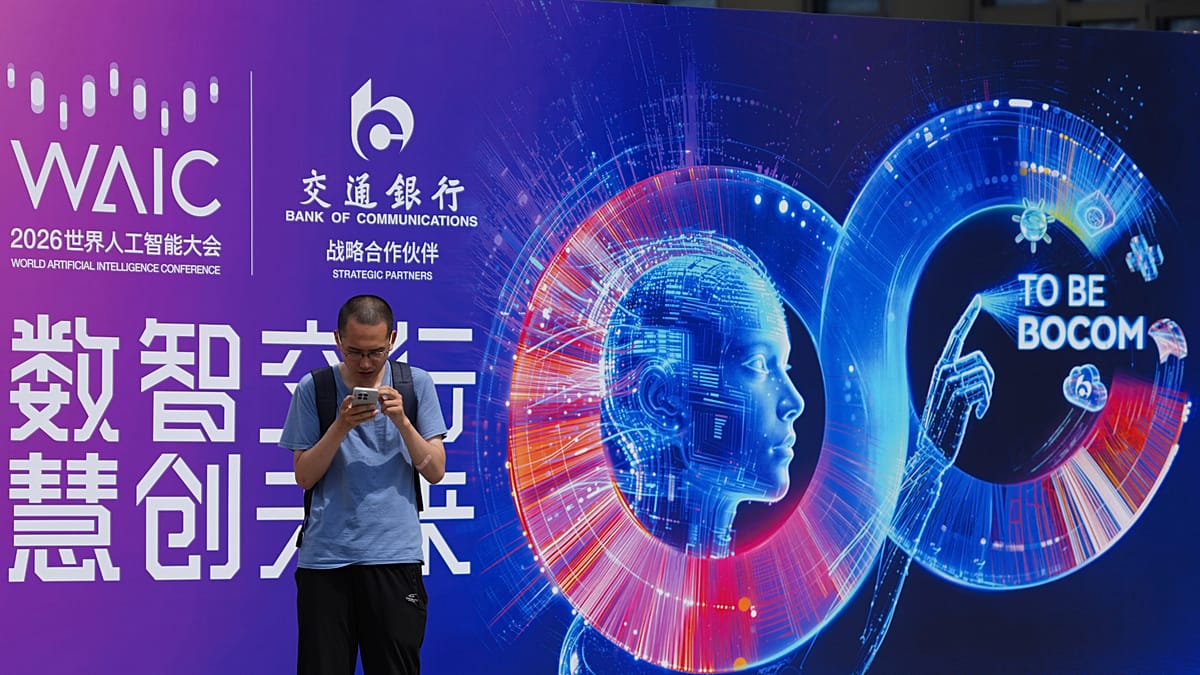
As the conversation around artificial intelligence heats up in Silicon Valley, Beijing shows no signs of hitting the brakes. While tech moguls on the West Coast debate the merits of slowing down AI development, a bustling scene unfolds in China, where over 1,100 employees are reportedly using world-class servers to cheat on evaluations. It’s a striking image, isn’t it? According to the latest AI Index from Silicon Valley, the performance gap between the leading models from the US and China has shrunk dramatically, from a staggering 1,300 points in May 2023 to a mere 39 points by March 2026. The US’s top model, Anthropic’s Claude Opus 4.6, still holds the lead, but the competition is heating up…
Now, let’s talk about what’s going on in China. They’re not just sitting around; they’re actively pursuing their own AI advancements. The country’s recent push includes an international agreement on AI safety, which has gained support from a whopping 28 nations and the European Union. Meanwhile, the UK appears to be leaning towards a more open approach rather than putting the brakes on innovation. It’s like a culinary competition where some chefs are sharing their recipes, while others keep them secret. In tech lingo, open-weight and open-source models are akin to giving away the full recipe of a dish—allowing anyone to whip it up at home. On the flip side, closed models like ChatGPT are like ordering that delicious dish at a restaurant, where you savor the end product, but the chef keeps his secrets tightly under wraps…
Nvidia’s voice is crucial in this narrative, considering they design about 90% of the specialized graphics processors, or GPUs, that power AI and machine learning globally. Just a few months ago, on July 17, President Xi Jinping unveiled the World Artificial Intelligence Cooperation Organization in Shanghai, a new intergovernmental body that aims to foster collaboration. Twenty-nine countries, including Russia, Kazakhstan, Laos, Pakistan, and Indonesia, signed the founding document, but interestingly, no major Western democracy was in attendance. Xi framed this initiative as a response to the needs of the Global South, offering 5,000 AI training opportunities to developing countries over the next five years. It’s a bold move, aimed at countering what he termed “AI sovereignty” arguments that are gaining traction in Europe.
And get this: American diplomats have been instructed to market US AI products as the best available, describing efforts to build rival AI systems as a waste of time and resources. It’s a real clash of ideologies, folks, and one that could shape the future of AI on a global scale.
So, what’s next? Will the West reconsider its approach while China forges ahead with its ambitious plans? Or will we see a new kind of tech race that pits open collaboration against closed secrecy? The stakes are high, and the world is watching closely…
Kaynak: Orijinal Haber