
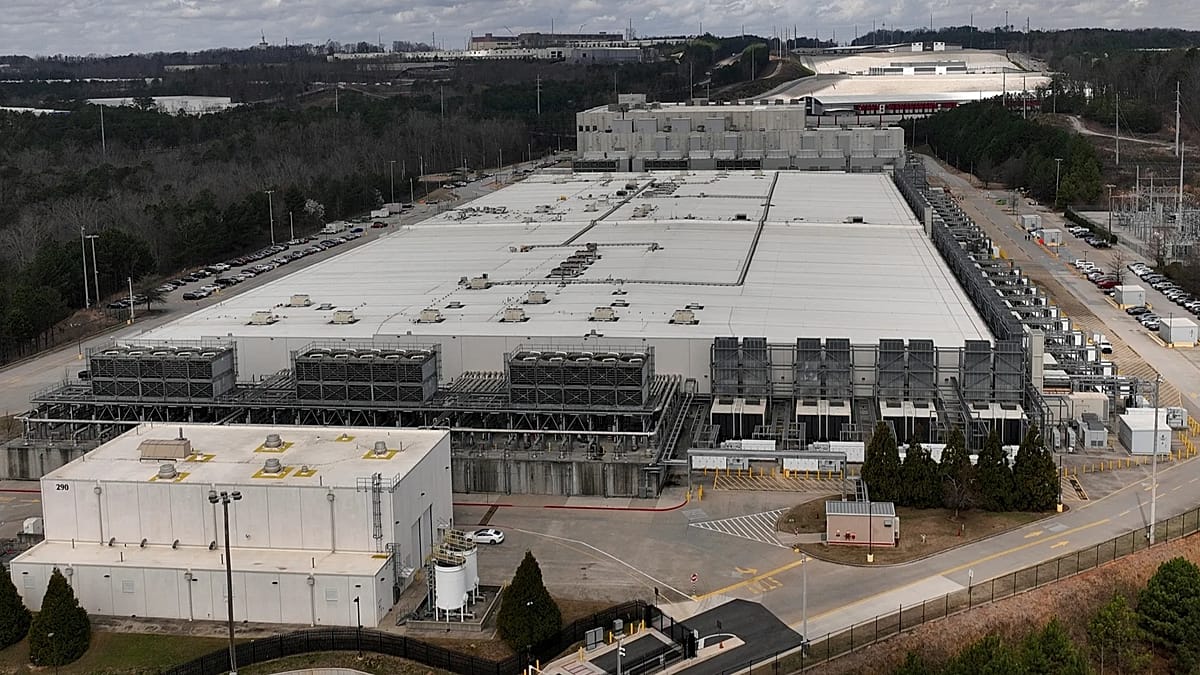
The boom of artificial intelligence is bringing with it a significant water challenge. In the United States, public frustration is escalating over the immense amount of water and electricity consumed by AI data centres. These tech giants, who have poured billions into these operations, claim they can tackle the water issue at least. Data centres, essentially huge warehouses packed with computer servers that fuel the internet and AI, are notorious for generating heat, necessitating large quantities of water to keep them cool. A report from consultancy Rystad Energy reveals that data centres worldwide guzzled an astonishing 222 billion litres (or 59 billion gallons) of water for cooling in 2025. If no action is taken, that figure could skyrocket to 644 billion litres by 2030, almost tripling! Rystad suggests that implementing measures to curb water consumption could keep the increase below 100%.
In a bold move, US chipmaker Nvidia recently touted its new system for designing and managing AI data centres, called DSX. This system, they say, could nearly wipe out water consumption at certain facilities. But hey, is that just a flashy promise? The industry is certainly feeling the heat to deliver results. Nvidia’s innovative closed-loop cooling system circulates liquid directly through the servers, getting as close to the chips as possible – which can heat up to over 80°C (176°F). However, there’s a catch! As Andy Masley, an independent researcher focused on AI and data centres, mentions, there’s a clear trade-off between water and energy use when controlling temperatures. Less water often means more electricity, as the liquid in sealed pipes still needs to be cooled, typically by blowing air over it. Nvidia seems to sidestep some of this by allowing the liquid to enter the servers at a warmer temperature of 45°C, compared to the standard 32°C used by most other systems.
But wait, there’s more! Microsoft, Amazon Web Services (AWS), and Meta have also chimed in, asserting that they too employ closed-loop cooling systems that don’t lead to net water loss. Yet, between 2022 and 2025, Microsoft and AWS used more water overall as they expanded their data centre operations, despite boosting their water-use efficiency by 25% and 37% respectively, according to their latest sustainability reports. It gets tricky, though – there’s no industry-wide standard dictating how firms should report their environmental efforts, making it hard to compare. And let’s not forget Elon Musk’s SpaceX, which has jumped into the data centre game after scooping up his AI company xAI. They’ve never released an ESG report, and in June, MSCI slapped them with the lowest ESG score possible.
Now, what’s the story here? According to Shaolei Ren, an engineering professor at the University of California, Riverside, companies typically have little motivation to cut water use purely for cost reasons. “There are incentives,” he remarks, but they’re more about public relations as opposition to data centres swells across the US. Upgrading older data centres to newer, water-efficient technology poses another challenge. However, it’s interesting to note that older facilities are often smaller and less powerful than the massive data centres popping up today, meaning they need less cooling to begin with. And here’s a kicker: the water directly utilized by data centres is just a fraction of their total water footprint. Significant amounts of water are required to generate the electricity that powers these centres and to manufacture the chips and servers themselves. In fact, in the United States, this indirect water use can be double that of the water consumed directly by the data centres.
So, what does this all mean? The clock is ticking, and the pressure is on for these tech behemoths to find solutions. Can they really minimize their water use while satisfying the insatiable thirst of AI systems? Only time will tell…
Kaynak: Orijinal Haber