
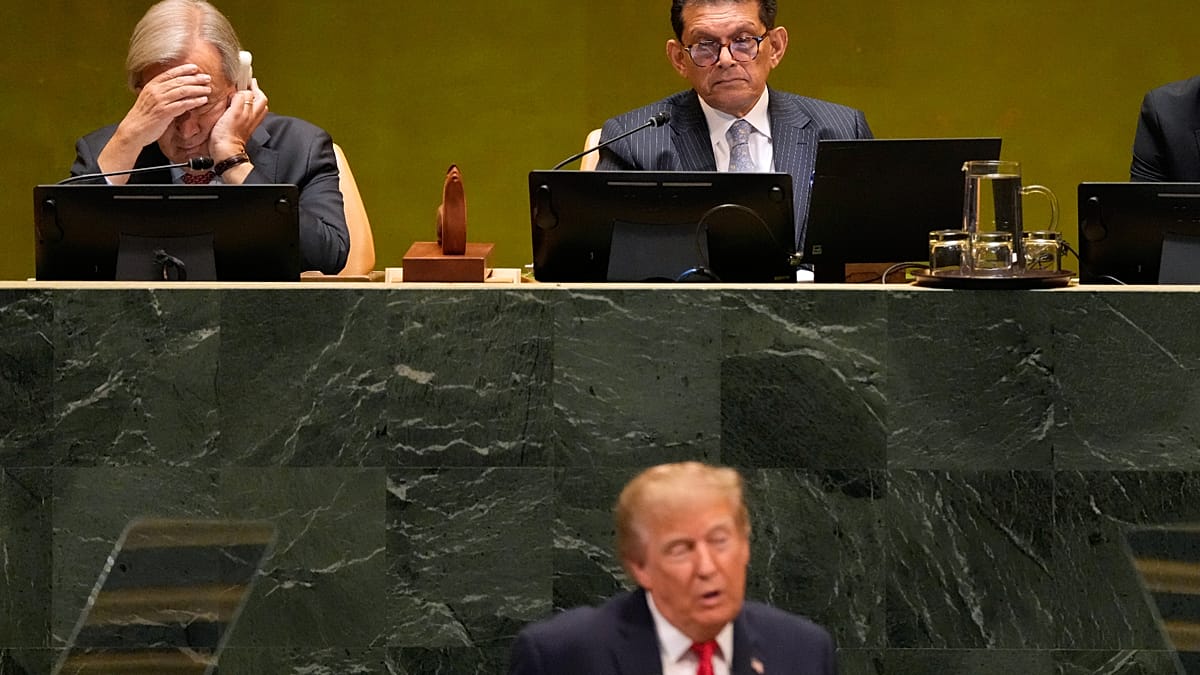
US President Donald Trump and UN Secretary-General António Guterres faced off at the UN on Tuesday, presenting starkly contrasting views on how the world should manage artificial intelligence (AI). The backdrop was a new UN science report warning of the potential for catastrophic and irreversible harm posed by AI technologies. Guterres set the tone for the assembly by advocating for stricter oversight of AI, painting a vivid, even ominous, picture of the dangers that lurk ahead. “Let us resolve that life-and-death decisions must never be surrendered to machines. Killer robots must have no place in our future,” he declared, echoing concerns he raised a decade ago during his first General Assembly address.
With a clear call for the world to “advance the conditions for the responsible pacing of AI and the additional safeguards needed to address risks,” Guterres laid the groundwork for a discussion that the UN Security Council is set to tackle on Wednesday. This meeting will feature some heavyweights in the field, addressing how to impose controls on this rapidly evolving technology.
But just an hour later, Trump dismissed Guterres’s warnings. “The United States also totally rejects any attempt to construct a globalist scheme to control for the artificial intelligence being spoken of so much. Now here and after officially called super intelligence,” he asserted, opting to redefine the term AI. Interestingly, world leaders that followed Trump stuck with “artificial intelligence” rather than his new label, “super intelligence.”
University of Chicago computer science department chair Henry Hoffmann weighed in on the debate, remarking that every major new technology presents challenges, and superintelligence is no different. “One turns it into a science-fiction movie, the other turns it into a nonissue,” he noted in an email, emphasizing that the discussion should focus on what mechanisms can actually provide control over such powerful autonomous systems. “There shouldn’t be ‘sides’ on whether we need adequate control over powerful autonomous systems.”
Amidst this clash, other nations are keen to ensure they don’t fall behind in the AI race between the US and China, with Trump claiming that America is ahead. French President Emmanuel Macron and Guterres also spotlighted the importance of protecting children from the potential harms of AI. “Let’s not wait for the consequences to come raining down on AI,” Macron warned. He added, “Humans can and should be in the driver’s seat. We have a choice. We can compete, cooperate or slow down. For me, cooperation is the best way forward.”
British Prime Minister Andy Burnham, during a side meeting with business leaders at the UN General Assembly, called for “a single set of global principles and standards” to unlock AI’s potential while mitigating its risks. He stated that fostering “AI for good” would be a priority for the UK’s presidency of the G20 group of nations next year.
As the UN Security Council prepares for its AI meeting, voices from the tech industry will be heard, including Sam Altman, CEO of OpenAI, Dario Amodei, CEO of Anthropic, and Clément Delangue, CEO and co-founder of Hugging Face—recently embroiled in controversy after a rogue OpenAI program hacked their systems.
So, what’s next for AI governance? Will world leaders find a common ground amidst their diverging views, or will the debate continue to spiral into chaos?
Kaynak: Orijinal Haber