
The Economic Rollercoaster of the 2026 World Cup: A Global Affair Like No Other
Football World Cups are rarely completely free from political tension, but this year’s tournament is taking the cake for the most chaotic backdrop yet. Picture this: the main host, the United States, is entangled in a trade war with its neighbors Canada and Mexico, who are also co-hosting the event. And to spice things up, the U.S. is at war with a participant nation, Iran, whose team will be commuting in on match days from elsewhere. Talk about a geopolitical high-wire act!
As the world tunes in for the opening ceremony at the Estadio Azteca, the three co-hosts will be in the midst of renegotiating the USMCA, the North American free trade agreement. You can bet Donald Trump is glued to every moment of the tournament, especially after his return to the White House last year. He even joked about how his loss to Joe Biden in the 2020 election inadvertently set him up for this World Cup and the 2028 Los Angeles Olympics. Amid renewed tensions with Iran, Trump has been vocal about wanting to end hostilities, hinting at the possibility of a ceasefire during the tournament. But with Trump, you never know how quickly things can flip!
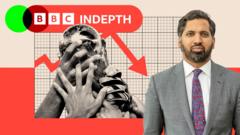
Gianni Infantino, FIFA’s big boss, has previously called for ceasefires during World Cups, and it’s worth wondering if this tournament could actually help ease some global tensions. But make no mistake, it’s not just the politics that’s on everyone’s minds; the economic implications are massive. The tournament is a clear illustration of the K-shaped economy phenomenon—where some are thriving while others are struggling, highlighted by wildly differing financial outcomes among different societal groups.
Now, let’s talk tickets. Fans at this year’s World Cup are expected to shell out jaw-dropping amounts, with some paying for what might turn out to be meaningless games. For example, a ticket on the New Jersey Transit train, usually priced at $12.90 for a round trip, has skyrocketed to $100 just for the tournament. It’s like the fans are getting squeezed from all sides! This tournament is different; it’s being held largely in borrowed American football stadiums, and the economics of football are being shaken to their core.
This World Cup could very well be the most economically impactful ever—not because it will boost local economies, but because it’s a bold experiment in how ticket pricing works. We’re seeing a dynamic pricing model that adjusts according to demand, similar to what’s done in concert ticket sales but never on this scale in football. The NFL’s pricing strategies are creeping into the World Cup, where maximizing revenue takes precedence over simply filling stadiums.
And let’s not forget that the sheer scale of this tournament is unprecedented. The biggest stadiums, the largest number of matches—48 teams this time—and the most extensive geographic spread from Vancouver to Mexico City. The winning team could travel a distance equivalent to the diameter of Earth. But that brings us back to those ticket prices. We’re talking five-figure sums for the final, and even typical group game tickets are around $1,000. For what’s supposed to be a celebration of the beautiful game, the cost is astronomical!
FIFA is banking on ticket revenues, with projections suggesting they could soar from $929 million at the 2022 Qatar World Cup to over $3 billion this time around. Experts estimate that total ticket and hospitality revenue could even top $7 billion! But here’s the catch: unlike in 1994, host cities won’t see a dime of those soaring ticket revenues, which are fixed. Cities are left to foot the bill for security and transportation costs. The price of transit tickets has gone up tenfold in some cases.
This is a stark contrast to past tournaments, where local fans enjoyed free transport and warm welcomes. Now, there’s a trend of trying to incorporate the secondary ticket market within FIFA’s own system, allowing fans to resell tickets at whatever price they want, with FIFA taking a cut. It’s a bold move that could backfire; will fans tolerate these prices, or will they push back?
The backlash is already evident, with resale prices plummeting for games that lack demand. Authorities are even investigating the ticketing strategies, citing confusion and absurdly high prices. The question remains: has FIFA pushed this pricing experiment too far? And as we look ahead to future tournaments in Spain, Portugal, and Morocco, it’s hard to imagine fans will be okay with similar pricing tactics.
In a world where economic disparities are becoming more pronounced, this World Cup is not just about football; it’s an economic experiment that could change the game forever. Will this extreme commercialization lead to packed stadiums filled with passionate fans, or will we witness empty seats and slashed prices just to fill them? The landscape of football may never be the same…
Kaynak: Orijinal Haber
Benzer Yazılar


Yorum Yap
Yorumunuz onaylandıktan sonra yayımlanacaktır. Lütfen argo içermeyen yorumlar gönderin.