
Elon Musk Becomes the World’s First Trillionaire as SpaceX Launches into the Stock Market!
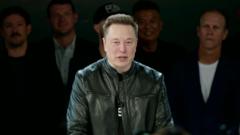
Elon Musk became the world’s first trillionaire on Friday after shares of his rocket company, SpaceX, skyrocketed during the biggest stock market debut in history. The founder of Tesla and SpaceX solidified his position as the richest person globally, with a staggering net worth of $1.11 trillion (£828 billion), according to Bloomberg’s rich list. This monumental event occurred as SpaceX, known for its innovations in rocket technology, telecommunications, and artificial intelligence (AI), was listed on the Nasdaq stock exchange with a valuation of $2.2 trillion.
The company initially set its share price at $135, but trading kicked off at $150 and quickly surged to an incredible $176.50, showcasing the immense investor enthusiasm surrounding Musk and his ventures. By the end of the trading day, SpaceX shares settled at approximately $161. This initial public offering (IPO) managed to raise $75 billion from eager investors and underwriters before the stock hit the open market.
Musk’s 42% ownership stake in SpaceX effectively gives him unilateral control over the company, allowing him to spend the invested capital as he sees fit. Bloomberg reports that his shares in SpaceX were valued at $767.1 billion at the close of trade, with an additional $53.8 billion in SpaceX options. He also holds $168 billion in Tesla shares and another $116.4 billion in Tesla options. This remarkable ascent to trillionaire status has ignited conversations about wealth inequality, as Musk’s fortune is now comparable to the entire economic output of Poland or Switzerland.
This level of wealth has already positioned Musk as a powerful and polarizing figure in global politics. He has previously contributed hundreds of millions of dollars to U.S. President Donald Trump’s re-election campaign after expressing criticism of the country’s leadership. Notably, Musk led the Department for Government Efficiency (Doge) for several months last year, where his significant cuts to government spending resulted in the closure of the U.S. Agency for International Development (USAID). Researchers from the Lancet medical journal have warned that such measures could lead to over 14 million additional deaths by 2030.
Musk’s controversial position has also led to clashes with various political leaders, including UK Prime Minister Sir Keir Starmer, particularly over pressing issues such as immigration and racial divisions. Following Musk’s trillionaire milestone, a wave of politicians, including Democratic Senators Bernie Sanders and Elizabeth Warren, voiced their disapproval. Warren emphasized the need for wealth taxes, calling Musk’s fortune a “wake-up call” to address the growing wealth gap.
Despite the glittering title of trillionaire, it’s important to note that Musk’s wealth is primarily on paper, heavily reliant on the fluctuating values of his stock holdings in both Tesla and SpaceX. He won’t be able to sell any of his SpaceX stock for at least a year, which raises questions about the sustainability and reality of his newfound status.
Moreover, SpaceX’s public listing is expected to create more than 4,400 new millionaires among its current and former employees, who received shares as part of their compensation. While the valuation of SpaceX is driven largely by optimism about its future earnings, the company has yet to demonstrate profitability. Financial filings reveal that SpaceX lost over $9 billion in 2025 and 2026 due to substantial investments in AI and other infrastructure.
The primary focus of SpaceX is the manufacture and launch of reusable rockets, as well as the production and launch of Starlink internet satellites. Following its acquisition of xAI, another company operated by Musk, SpaceX is also venturing into the AI sector. The funds raised through the IPO are set to “fuel its growth strategy” around rockets, satellites for the expanding Starlink service, and ambitious plans to build data centers in orbit.
Nancy Tengler, head of Laffer Tengler Investments, who has placed an order for SpaceX shares, has called the company’s AI business a “cash incinerator,” despite Musk’s grand aspirations. “It’s important to take some of the projections with a grain of salt,” she remarked, yet she remains optimistic about the company’s long-term potential, noting, “Our investment horizon is three, five, and even ten years.” Tengler also speculated that a merger between SpaceX and Tesla could occur within the next two years, potentially creating a company worth even more than either one alone.
SpaceX’s vision extends far beyond mere satellites and mergers. Their IPO prospectus outlines an ambitious goal: “To build the systems and technologies necessary to make life multiplanetary, to understand the true nature of the universe and to extend the light of consciousness to the stars.” They are working towards what they call the “lunar economy,” which involves transporting people and cargo to the Moon and Mars—an endeavor that would require regular operations to establish a functional economy.
However, SpaceX candidly admits uncertainty about the success of such initiatives, stating, “Many of our initiatives… involve significant technical complexity, unproven technologies or technologies that do not exist, and such initiatives may not achieve commercial viability.” Despite this uncertainty, investors remained undeterred during the trading frenzy on Friday. Susannah Streeter, chief investment strategist at Wealth Club, stated that the surge in share prices reflects “huge interest in Elon Musk’s vision.” She added, “He has long been reaching for the stars with his extra-terrestrial ambitions, and it appears plenty of investors share his enthusiasm for the future.”
Nevertheless, she cautioned that Friday’s rally was likely driven more by hype and scarcity than by solid fundamentals. While many individual investors eagerly sought to grab a piece of SpaceX’s listing, concerns linger about the unintentional exposure of investors, such as pension funds that may invest in index-linked funds affected by fluctuations in SpaceX’s stock price.
Moving forward, the big question for investors is not just about the immediate trading activity following the IPO but rather how the price will hold up in the long term. “The question on SpaceX is less about the immediate trading after IPO,” said Samel Kerr, who leads equity capital markets research for Mergermarket. “It’s more about how the price holds over the longer term.”
Kaynak: Orijinal Haber
Benzer Yazılar



Yorum Yap
Yorumunuz onaylandıktan sonra yayımlanacaktır. Lütfen argo içermeyen yorumlar gönderin.