
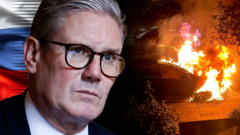
Roman Lavrynovych, a 22-year-old Ukrainian builder, was found guilty on Monday of conspiring to commit arson after he set fire to the home of UK Prime Minister Sir Keir Starmer. This dramatic incident, which raised serious questions about domestic security, was part of a larger, calculated campaign of sabotage orchestrated by Russian operatives. Lavrynovych’s handler, identified only by the initials EL, hinted at a sinister motive in a message stating, “Look, you attacked the home of a very high-ranking person in Britain. I’ll send you money, you need to leave the city.” But it was too late; Lavrynovych was apprehended just hours later.
Through an in-depth investigation, the BBC has uncovered that this arson was not an isolated act but rather a segment of a broader strategy of provocation and misinformation linked directly to the Russian state. Evidence suggests that EL is actually Evgeny Lyukshin, a 23-year-old Russian diplomat who has been trained in information warfare. He is reportedly close to the upper echelons of power in Moscow. It’s alarming to think that the very machinery of a state could be behind such a brazen attack on a foreign leader.
The arson is suspected to be part of a remote operation where Russian operatives utilized social media and the messaging app Telegram to create fake far-right and Muslim groups. These groups were instrumental in organizing acts of vandalism across the UK, aimed at inciting division and fear among the populace. Interestingly, accounts operating out of Russia propagated false narratives regarding the motives behind the attacks, further complicating the already murky waters of misinformation. Prominent figures in the far-right movement, like Tommy Robinson, then spread these lies, amplifying the chaos. The Russian embassy has denied any involvement, claiming, “We reject any attempt to associate Russia or its foreign ministry with unlawful activities.” They maintain that Russia poses no threat to the UK or its people.
During the trial, Lavrynovych and another accomplice, Stanislav Carpiuc, 27, were found guilty of conspiring to target property linked to Starmer. A third man, Petro Pochynok, 35, was acquitted. The first fire ignited last year when a Toyota, once owned by the Prime Minister, was torched in north London. Following that, two additional arson attacks were carried out: one at the entrance of a block of flats where Starmer once resided and another at his current residence. The odd part of the trial was the absence of any focus on the true mastermind behind the operation. The identity and intentions of EL, who had offered Lavrynovych financial incentives for the attacks, were purposely shrouded in secrecy.
In the courtroom, EL was cryptically referred to as “EL Money,” a name saved in Lavrynovych’s phone. Yet, on Telegram, he merely used the initials “EL.” This was the platform where he recruited Lavrynovych, initially connecting through a group aimed at helping Ukrainians find work in London. From this seemingly innocent connection, Lavrynovych was pulled into a world of escalating criminality, tasked with graffiti and arson, though he knew he was crossing a line.
Messages from EL revealed his glorification of Putin and Russia while disparaging the Ukrainian people. For example, he boldly claimed, “It is obvious that Putin is the leader of the white race.” He also sought “painters to do graffiti” in London, but in other chats, he employed deeply offensive language towards Ukrainians. His messages incited violence, calling for attacks on conscription centers in Ukraine and urging those supportive of the “white Slavic race” to embrace the idea of a “real Third Rome.”
Moreover, the trial neglected to mention what Lavrynovych’s posters, which he put up on EL’s orders, were actually advertising—a far-right group named Direct Action UK. This group was deceptively designed to appear as an organic British entity but was found to be an online creation by Russian operatives, aiming to create discord among ordinary citizens in the UK. Interestingly, the timestamps on group messages pointed back to Moscow, with a peculiar use of Cyrillic letters.
Direct Action exploited real-life events, such as the Southport murders, to spread its propaganda. Videos circulated branding Sir Keir Starmer a traitor, inciting hatred against Muslims and offering monetary rewards for violence and arson. The consequences were dire, with several mosques and an Islamic school vandalized in London after the group offered compensation for Islamophobic graffiti.
This situation has drawn attention from anti-racist organizations like Hope Not Hate, which flagged the group to counter-terror police back in February, warning that Russians might be grooming UK residents for potential terror attacks. Yet, their concerns went largely unacknowledged.
It’s important to note that before EL took the reins of fake far-right groups, he was also involved in setting up a fraudulent Islamic organization called the Takbir Foundation, which aimed to provoke far-right sentiments through vandalism. This organization sought to recruit Muslims for tasks that were far from innocent, blurring the lines between community and division.
With the recent arson attack on the Prime Minister’s property now serving as a propaganda tool online, misinformation has spread like wildfire, with false claims circulating that the suspects were involved in a scandal. This narrative was propelled by Robinson, who alleged that Starmer had inappropriate connections with Ukrainian male sex workers, a rumor that gained traction due to its sensational nature.
This incident is just one of many in a broader pattern of Russian-backed sabotage aimed at destabilizing Europe and its allies. The reliance on proxies for carrying out these acts of violence and espionage raises the stakes, complicating the accountability and denial of state involvement. In Ukraine, there are reports that a third of individuals involved in Russian sabotage networks across Europe are Ukrainian nationals.
What’s next in this troubling saga? The connections between misinformation, state-sponsored sabotage, and domestic security continue to unravel, leaving many questions in their wake.
Kaynak: Orijinal Haber