
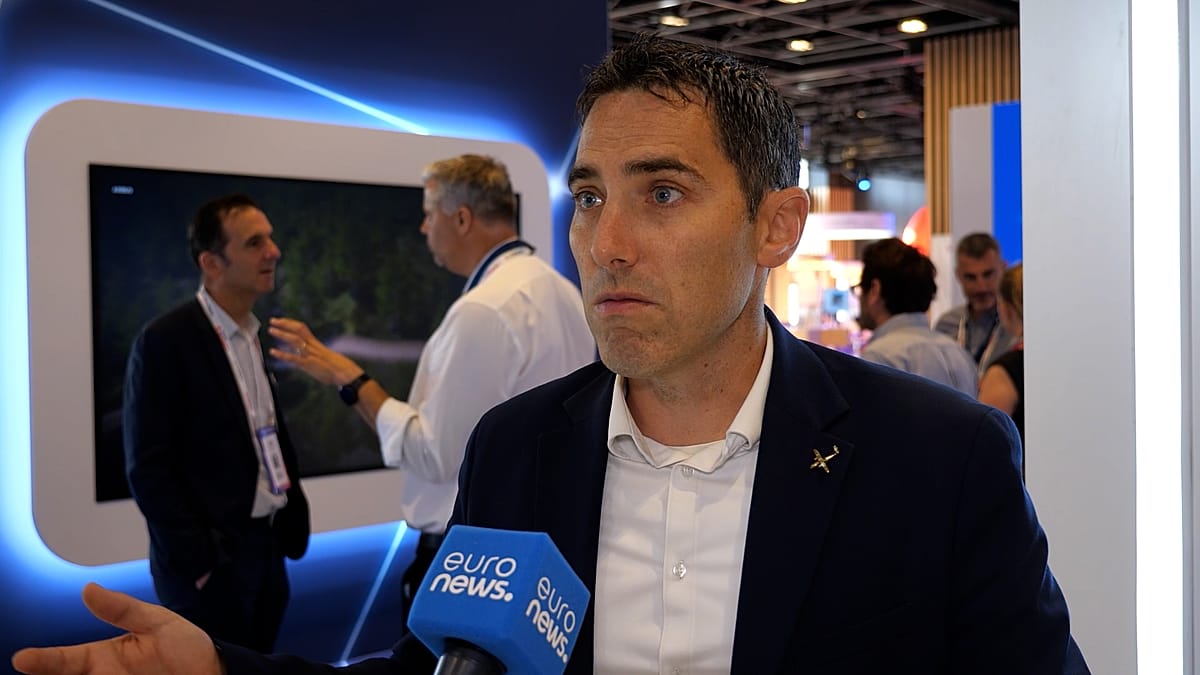
As demand for air travel expands, French aircraft manufacturer Airbus is testing cutting-edge technologies that could revolutionize the way aircraft navigate through increasingly crowded skies and bustling airports. The company’s forecasts suggest that the number of aircraft in the air could double in the next two decades, while airport infrastructure won’t keep up with this growth. What does this mean? It means planes will have to deal with tighter and more complex environments, from busy taxiways to unpredictable weather patterns driven by climate change. “We need to find different ways to think and use the technology we have to overcome those complexities,” said Jonathan Rigaud, who leads Airbus’ Optimate demonstrator project, during an interview with Euronews Next at VivaTech in Paris.
So, what’s the Optimate project all about? According to Airbus, it’s a test initiative aimed at smart automation technologies, incorporating tools like artificial intelligence, quantum sensing, and data fusion. Rigaud pointed out that the project has three primary objectives: safeguarding an aircraft’s route, optimizing operational efficiency, and assisting pilots during challenging conditions such as heavy rain or fog. Airbus isn’t just resting on its laurels either—they’re also experimenting with radar, LiDAR, cameras, and computer vision to help aircraft identify obstacles or risks in their surroundings. “AI can help us figure out whether something is familiar or something we need to steer clear of,” Rigaud noted.
Taxiing, the phase when aircraft maneuver around the airport before takeoff or after landing, is another focus area for the Optimate project. Rigaud highlighted that airplanes currently spend over 20 minutes on average “rolling and not flying,” which underscores the need for enhancements in ground movement. Airbus is testing innovative solutions to facilitate more efficient communication between aircraft, airlines, and air traffic control, aiming to select optimal taxi routes and avoid unnecessary fuel consumption. Imagine this: helping planes to start their engines later based on real-time traffic data to save both fuel and emissions. “The goal is to be as optimized as possible,” Rigaud emphasized.
In their quest for innovation, Airbus has even utilized a truck-like demonstrator, which they cleverly call an “aircraft on wheels,” to trial new functionalities before determining what could be integrated into current or future aircraft. Over the past two years, they’ve logged more than 400 hours of testing at complex airports like Paris Charles de Gaulle, which boasts an impressive 115 kilometers of taxiways. “Now that we’ve tested it, we’re starting to understand what we need to incorporate into our current and future aircraft,” Rigaud said.
Another intriguing avenue Airbus is pursuing is navigation that doesn’t solely depend on a single system like GPS. Recent geopolitical tensions have highlighted risks such as GPS jamming and spoofing, making backup navigation systems more crucial than ever. Rigaud clarified that GPS isn’t the only means of navigation for aircraft today; they also utilize inertial systems. Airbus is exploring advanced technologies, including quantum sensing, ground-based visual navigation, and sensor fusion. Quantum sensing leverages principles of quantum physics to measure movement or acceleration with outstanding precision, which could allow aircraft to navigate without relying solely on satellite signals. Meanwhile, sensor fusion combines data from multiple sources to provide a clearer picture of the environment. “With the computation we have, we’ve tested different ways to not be tied to one system and to ensure robustness,” he mentioned. Importantly, he reassured that pilots will continue to make critical decisions, with automation stepping in to enhance the information available to them.
Bakalım, bu teknolojiler havacılığı nasıl dönüştürecek? Gelişmeleri takip ediyoruz…
Kaynak: Orijinal Haber