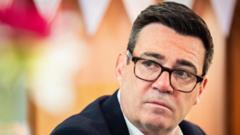
Andy Burnham has been warned that the UK economy could barely grow next year if the disruptions in the Strait of Hormuz persist. Treasury sources have indicated that internal modeling presented to the new Prime Minister and Chancellor suggests that UK GDP growth could plummet to as low as 0.3% in 2027, a troubling forecast first reported by Bloomberg. Government officials are continuously preparing for various scenarios, but the outlook remains grim.
The UK economy kicked off the year with a strong performance, but growth has since stalled, largely due to the ongoing conflict in the Middle East, which is affecting numerous businesses across the board. The Iran war has significantly driven up oil and fuel prices, not to mention the disruption to supply chains. As we look ahead, official figures are set to reveal how much the economy grew between April and June of this year. Economists are anticipating a growth of around 0.4% for those three months, but will it be enough?
Burnham and Chancellor John Healey were recently presented with a reasonable worst-case scenario, envisioning the Strait of Hormuz remaining effectively closed for the next five months, along with no permanent peace deal between the US and Iran until the new year. The Treasury’s modeling for that scenario estimates that the UK economy would grow by 0.9% in 2026—slightly below the 1.1% forecasted by the Office for Budget Responsibility (OBR) back in March. However, the projection for next year paints an even darker picture, with only a 0.3% growth anticipated, far lower than the OBR’s 2% target.
As the UK faces mounting challenges, Burnham and Healey will likely be under pressure to use the upcoming Budget on October 28 to alleviate the financial burden on households and businesses. Since taking office just three weeks ago, Burnham has rolled out several policies, including the removal of VAT from domestic electricity bills and accelerating the end of “subscription traps.” But he emphasized this week that the main focus should be on the economy’s recovery.
On the flip side, Chancellor Healey has committed to maintaining “strong fiscal disciplines,” and his 2024 manifesto pledges not to raise income tax, VAT, or National Insurance contributions. He has also promised to adhere to the fiscal rules established by former Chancellor Rachel Reeves, which include a vow to balance day-to-day spending with tax revenues by the decade’s end.
As the UK economy begins to show signs of growth again in May, the Prime Minister has admitted that the cost of living assistance currently provided is insufficient and hinted at the possibility of further support. A joint memo from the Prime Minister and Chancellor has urged ministers to stick to spending limits.
So, what’s next? How will the government navigate these troubling economic waters? We’ll be keeping a close eye on developments…
Kaynak: Orijinal Haber