
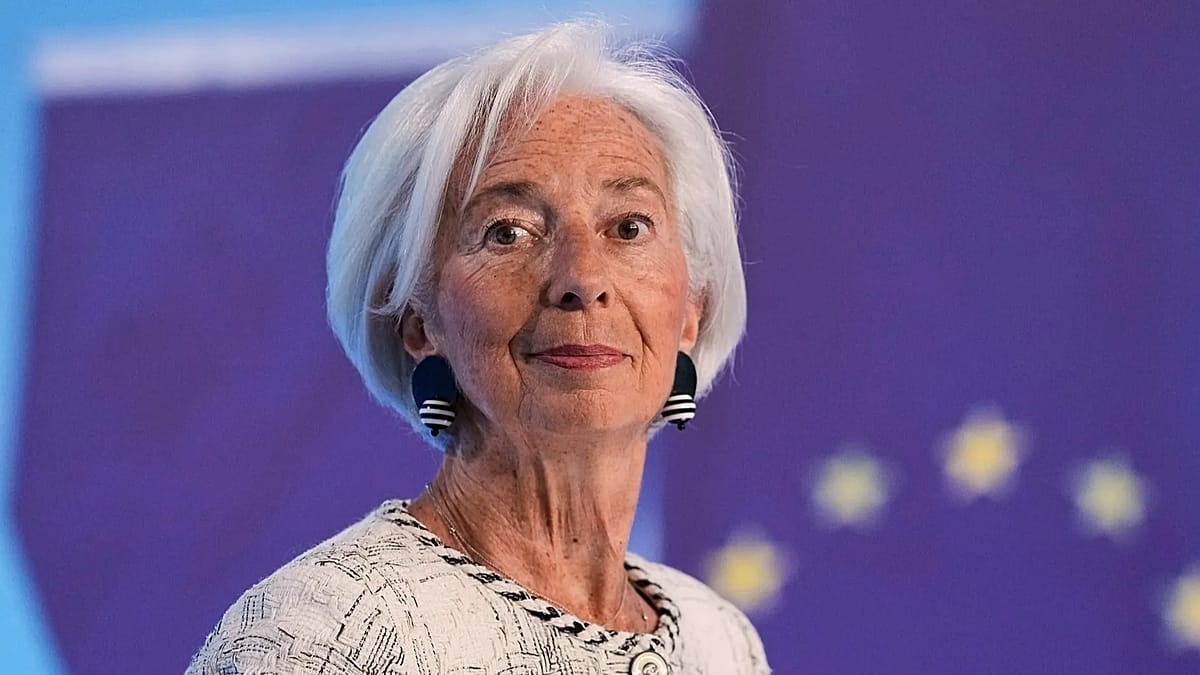
European Central Bank (ECB) President Christine Lagarde has stepped up to defend the recent decision to increase interest rates. This marks the ECB’s first rate hike since 2023, a move initially spurred by skyrocketing energy prices following Russia’s full-scale invasion of Ukraine. During a briefing with journalists on Thursday, Lagarde emphasized that the decision is “robust across three different scenarios.”
The ongoing conflict in the Middle East, which reignited in February, has sent shockwaves throughout Europe. The unpredictable closure of the Strait of Hormuz has driven oil and gas prices to dizzying heights, leaving European importers feeling the pinch. Lagarde pointed out that the ECB’s strategy will continue to evolve throughout much of 2025, especially as Eurozone inflation climbed to 3.2 percent in May, the highest figure seen since September 2023, fueled by a staggering 10.9 percent spike in energy costs.
Looking ahead, the European Union forecasts a slowdown in GDP growth, dropping from 1.1 percent in 2026 to 1.4 percent in 2027, while inflation is expected to rise from 3.1 percent in 2026 to 2.4 percent in 2027. Lagarde was clear that the ECB isn’t locked into a specific rate path. Despite all the uncertainties in the air, she shared that the bank has projected three potential short-term scenarios for June 2026: mild, adverse, and severe.
In the milder scenario, oil prices stabilize, which would see GDP growth rise from 0.8 percent in 2026 to 1.4 percent in 2027, while inflation would drop from 2.9 percent in 2026 to 1.8 percent in 2027. On the flip side, the adverse scenario assumes continued surges in energy prices, creating high uncertainty alongside international spillovers. Here, real GDP growth would sit at 0.7 percent in 2026, creeping up to 0.9 percent in 2027, while inflation could hit 3.3 percent in 2026 and 3.0 percent in 2027.
Now, if we talk about the severe scenario, it’s pretty grim. The EU would be grappling with a stronger and more persistent energy price shock, causing real GDP growth to slow down to 0.5 percent over 2026-2027 before experiencing a slight rebound in 2028. Lagarde reiterated that the ECB’s top priority remains controlling inflation.
Critics, however, are voicing concerns, arguing that such decisions are hitting the most productive and innovative sectors the hardest. “Such a decision will not bring down energy prices,” they argue. “It will, however, make clean energy investments pricier, which is the only solution for long-term stability.”
There’s a lot at stake here, folks. The rise in borrowing costs could jeopardize Europe’s competitiveness, as the higher expenses could deter investments in cleaner industries. Lagarde pointed out the urgency for reforms that enhance the euro area’s growth potential and accelerate the transition away from fossil fuels. “This is more vital than ever,” she stated, emphasizing the need for action.
Bakalım, bundan sonra ne olacak? Gelişmeleri takip ediyoruz…
Kaynak: Orijinal Haber