
Water Cannon Deployed in Belfast Amidst Ongoing Unrest Following Knife Attack

A water cannon has been deployed to disperse a large crowd after a second night of disorder in Northern Ireland, all stemming from a knife attack in

A water cannon has been deployed to disperse a large crowd after a second night of disorder in Northern Ireland, all stemming from a knife attack in Belfast. Riot police found themselves under sustained assault from a group hurling bricks, bottles, and chunks of wood at a major roundabout northwest of Belfast. While additional officers were brought in to handle the situation, the chaos on Wednesday was not as intense as the violence that erupted the previous night.

Public transportation across Northern Ireland was shut down, and many schools closed early on Wednesday to prepare for potential disruptions. The usually bustling Belfast city center was eerily quiet, with numerous businesses shuttering their doors by lunchtime. The water cannon was seen deployed at the Sandyknowes roundabout in Glengormley, roughly eight miles (about 13 kilometers) northwest of the heart of Belfast. Footage captured showed dozens of individuals clad entirely in black, faces covered, ripping up fences and driveways from nearby homes to use as projectiles.

Things escalated quickly, with a large Department for Infrastructure vehicle going up in flames, and bins catching fire too. The gathered crowd attempted to ignite a derelict property nearby and some even threw petrol bombs toward the police lines. Reports suggest they were trying to breach a hotel that houses asylum seekers.

Meanwhile, protests erupted across Northern Ireland, though many remained peaceful. In east Belfast, where significant trouble occurred the prior night, about 150 people assembled under the watchful gaze of police. Authorities reported minimal disturbances and only a handful of arrests. Over in Coleraine, County Londonderry, more than 100 individuals gathered at a row of houses, voicing their concerns about multiple occupancy homes (HMOs) and those residing within them before dispersing.

In Derry, police advised motorists to steer clear of the Ardmore Road at the Church Brae junction due to items ablaze. Approximately 140 protesters convened at the Stormont estate in Belfast. Earlier, Hadi Alodid, a 30-year-old man originally from Sudan, appeared in court charged with attempted murder related to the knife attack in north Belfast on Monday that left the victim, Stephen Ogilvie, with severe injuries. Ogilvie, in his 40s, has tragically lost his left eye and suffered damage to his right eye, as well as injuries to his neck and back.

His family issued a statement on Wednesday night, sharing that he was in a stable condition, but felt compelled to speak out due to the “false information circulating on social media.” They called for “peaceful protest as the only way forward” and emphasized the “valuable contributions many migrants make to our society.”

The backlash against the attack, and the ethnicity of the alleged perpetrator, sparked protests that night across various regions in Northern Ireland. Groups of masked men set fire to houses, a bus, and vehicles, primarily in Belfast, causing several families to flee their homes in sheer panic. Petrol bombs were also directed at police in multiple locations. Yet, many other protests in areas like Ballymena, Londonderry, and Antrim proceeded without incident.

On Wednesday night, the Stormont Executive issued a firm statement from all ministers denouncing the violence. They reiterated calls for calm, emphasizing that the turmoil has inflicted significant damage on communities, instilled fear, and jeopardized innocent lives.

The Royal College of Nursing reported that some of their staff were “stopped by masked men” while attempting to get to work on Tuesday night. RCN director Rita Devlin mentioned that these medical professionals were asked to show their credentials and were unable to reach their workplaces. She noted that some of these nurses hailed from overseas and were left “absolutely petrified.”

Prime Minister Sir Keir Starmer condemned the horrific attack on Monday night in north Belfast, stating that while people were understandably outraged, the resulting acts of violence and arson were “totally unjustified.” Conservative leader Kemi Badenoch described the scenes as “deeply disturbing,” insisting that while people had a right to be angry, no one has the right to drive families from their homes or engage in violence against public property and police.

Northern Ireland Secretary Hilary Benn remarked that it’s now up to those involved in the disturbances to decide whether they want to keep “leaving children absolutely terrified as they’re taken out into the dark with flames and screams surrounding them.” PSNI Chief Constable Jon Boutcher urged the community to resist being swept away by online narratives and cautioned against being influenced by individuals who are uninformed about Northern Ireland.

So, what’s next? Will the unrest continue, or will calm be restored? The situation remains tense, and all eyes are on Northern Ireland as events unfold.

Kaynak: Orijinal Haber
Belfast Residents in Shock After Night of Violence and Destruction

Families in Belfast, including one with a two-month-old baby, are grappling with the aftermath of the violence that erupted on Tuesday night, forcin

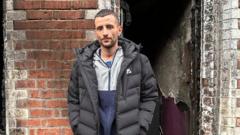
Families in Belfast, including one with a two-month-old baby, are grappling with the aftermath of the violence that erupted on Tuesday night, forcing them to flee their homes amidst raging fires. Several houses across the city were set ablaze following a chaotic night that was triggered by a knife attack on Monday evening. Jamie Corrie, a resident whose home of 13 years was reduced to ashes, expressed his heartbreak, stating, “Watching it burn down was a feeling I’ll never get over.” Standing outside the charred remains of his house on Lendrick Street in east Belfast, he lamented, “By the time firefighters arrived, my house was already engulfed in flames.” He explained that the fire started when a car belonging to “foreign nationals” next door was set on fire, which then spread to his property.

Corrie, who has been a part of the east Belfast community for over a decade, shared his devastation: “I told them before they were lighting the car, I said ‘this is my property.’ Standing there watching your house get burnt… that’s a feeling I’ll never get over.” He questioned the logic behind the violence, asking, “What does this resolve? Burning cars out, wrecking your own community, and now one of their own has just lost their home.” Everything inside his house was lost, including irreplaceable sentimental items. Thankfully, his children were not present during the chaos.

Yura, a 19-year-old member of a Ukrainian family living on Lendrick Street, described the terrifying scenes of that night. “My neighbor’s house was set on fire, and my front door caught fire too. It had to be kicked out to stop the flames from entering the house,” she recalled. With her dog by her side, she had to escape through the back door. “We even tried to break into my neighbor’s house to rescue their dog.” Fortunately, she found refuge with friends nearby for the night.

Anselme Shima, another east Belfast resident living close to where the violence unfolded, expressed his devastation and fear for his children’s safety. “I didn’t know what I could do to protect them,” he said, echoing the sentiments of many who felt vulnerable during this upheaval. Healthcare workers are also feeling the strain of the unrest. Biji Jose, a senior nurse from the Northern Ireland Indian Nurses Forum, has been in Northern Ireland for 23 years. She expressed concern that her colleagues from the Indian community may consider leaving due to the recent violence. “Junior colleagues have reached out, deeply worried about their safety,” she noted, observing anxious faces among her peers.

One man, originally from India and residing in north Belfast, announced his decision to leave Northern Ireland after the violence. “We’re leaving right now,” he confided to BBC News NI. “I didn’t sleep all night. It was horrible; it felt like a war zone. Everything was burning, glass was shattered, and everyone was hiding in their homes. No one dared to come out; people were terrified.” He has spent 25 years in the UK, with the last four in Northern Ireland, but the fear of violence proved too much.

Ozer Soy-Suren, co-owner of a Turkish barber shop in Ballyclare, expressed his sorrow over the targeting of his business during the unrest. He mentioned that their shop has been a staple in the community for 20 years, and staff spent the morning cleaning up the damage from the previous night. “We knew the protest was going to happen, so we left a little early to keep ourselves safe,” he said, though he appreciated the local community’s support as people visited the shop to check on staff.

Pastor Jack McKee, who assisted those affected on Crumlin Road, shared that some individuals he was helping had been part of his church for 20 years. “They’re good Christian people, and they’re being displaced just because of their race,” he said, emphasizing the need for compassion and support.

In the midst of this turmoil, Hadi Alodid, a 30-year-old originally from Sudan, appeared in court charged with attempted murder following the attack that sparked both peaceful protests and subsequent disorder. The victim, Stephen Ogilvy, suffered severe injuries, including the loss of an eye. His family has called for peaceful protests as the only way forward, amidst the devastation that has rocked the community.

Houses across Belfast have been set on fire following the knife attack earlier this week, marking a significant escalation in tensions. Residents of east Belfast are left to grapple with the destruction and uncertainty that has unfolded on their streets.

Kaynak: Orijinal Haber