
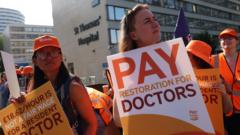
Resident Doctors in England End Strikes with Accepted Pay Deal!

Resident doctors in England have made a significant decision, voting to accept the government’s pay offer, which includes the payment of exam fees.

Resident doctors in England have made a significant decision, voting to accept the government’s pay offer, which includes the payment of exam fees. The British Medical Association (BMA) emphasized that these strikes, which stirred considerable tension in the healthcare system, were unnecessary. The focus, according to the BMA, should have always been on securing more jobs for doctors, better pay, and a well-staffed National Health Service (NHS) that can serve patients effectively for years to come.

In a contrasting scene, Northern Ireland’s resident doctors are gearing up for a 24-hour strike that will kick off at 07:00 BST on June 29. This highlights the ongoing unrest in the healthcare sector, as these doctors—who are qualified professionals having completed their medical degrees—make up nearly half of all doctors in England. They are the backbone of the NHS, working tirelessly in critical areas such as Accident & Emergency (A&E) departments and general practice (GP) surgeries.

After finishing their initial medical degree, these dedicated individuals undergo two years of mandatory postgraduate foundation training. Many opt to specialize further in various fields of medicine or surgery. It’s interesting to note that they were previously referred to as “junior doctors,” but starting September 2024, the government has decided to change their title to better reflect their expertise and contributions to healthcare.

The pay deal acceptance marks a pivotal moment for doctors and the NHS alike. However, the uncertainty looms over the ongoing strike in Northern Ireland, as doctors there continue to voice their concerns and fight for better conditions. This situation paints a broader picture of the challenges faced by healthcare workers across the UK.

This breaking news is still evolving, and more details are expected shortly. So, keep your eyes peeled for updates! You can also stay informed by following @BBCBreaking on X or through the BBC News App on your smartphone or tablet for the latest developments.

Kaynak: Orijinal Haber

Resident Doctors in England Prepare for Their 16th Strike Over Pay Dispute

Resident doctors in England are set to take to the picket lines once again, kicking off their 16th strike over ongoing pay disputes. The fresh round

Resident doctors in England are set to take to the picket lines once again, kicking off their 16th strike over ongoing pay disputes. The fresh round of walkouts is scheduled to begin at 07:00 BST on Monday, June 15, and will continue until 06:59 on Friday, June 19. This decision follows a recent meeting between the British Medical Association (BMA) and the newly appointed Health Secretary James Murray, who took over from Wes Streeting earlier this month. It’s been reported that Murray has firmly stated he is unwilling to negotiate on pay, labeling the union’s demands for increased compensation as “unrealistic and unaffordable.”

Now, let’s talk numbers. Over the past four years, resident doctors have seen pay rises totaling 33%, including a 3.5% bump this year, which brings starting salaries to a bit over £40,000. The most seasoned residents are raking in around £76,500 as base pay. But, yahu, these figures don’t tell the whole story. They can pocket even more by working unsociable hours or adding extra shifts. Despite this, the BMA insists that, when you adjust for inflation, these doctors are effectively earning a fifth less than they did back in 2008. That’s a big deal, right?

Dr. Jack Fletcher, the BMA’s resident doctor leader, shared his disappointment, saying, “We had hoped that a change in leadership at the Department of Health and Social Care would lead to a change in approach.” But alas, he continues, “We’re facing the same unwillingness to budge that we encountered under Mr. Streeting.” It seems the hope for a fresh perspective has fizzled out, with Fletcher noting, “We were ready to give Mr. Murray some time to find his footing, but he had a real chance to break this stalemate. Unfortunately, he hasn’t taken it.”

The BMA had previously received an offer from ministers in March, which included additional training positions, quicker career progression, and plans to cover expenses like exam fees. But guess what? They turned that down, and that led to a six-day strike in April. Murray expressed his disappointment, saying, “I was clear with the BMA that after a 33.4% pay rise over the last four years—the highest in the public sector—their demands for further substantial increases this year are unrealistic and unsustainable.”

Matthew Hopkins from The NHS Alliance, representing health managers, weighed in, calling the strike “rash and wholly irresponsible.” He warned that this action could jeopardize the recent progress made in reducing patient waiting times and enhancing productivity within the health service. It’s a tough situation, folks.

As if that’s not enough, there’s even a new BBC documentary highlighting the case of 16-year-old Larissa, who went missing from her home in Glasgow last year. And then there’s Don Taylor from Bury, Greater Manchester, who’s been grappling with psychosis for the last ten months. It’s a heavy load on the health system, and with live births in England and Wales hitting their lowest since 1977, and the average age of first-time mothers creeping up, the pressure is mounting.

So, what does the future hold for these resident doctors? Will their voices finally be heard, or will they continue to struggle for fair compensation? We’ll keep you updated as the situation unfolds…

Kaynak: Orijinal Haber