
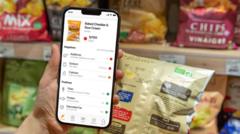
In the bustling aisles of a Hyper U supermarket west of Paris, a mother named Nathalie finds herself in a tight spot. With a packet of biscuits in one hand and her smartphone in the other, she’s grappling with the reality of her son Malo’s favorite snack, which she just discovered is loaded with E450—an additive that raises her eyebrows. “Look at that!” she exclaims, her frustration palpable. The app she’s using turns the packaging red, signaling danger. “Malo hates shopping with me now,” she admits, scanning for better alternatives.
This scenario is becoming increasingly common as more people turn to apps like Yuka, which has amassed 85 million users across 12 countries since its inception in 2015. Yuka employs a traffic light system to help users make informed choices: green means good, red indicates bad, and yellow suggests there’s room for improvement. The app is particularly popular in the U.S., where it boasts around 28 million users—far surpassing France’s six million and the UK’s five million. And guess what? Even Donald Trump has given this app a thumbs up!
Yuka’s co-founder and CEO, Julie Chapon, made a strategic move three years ago to relocate to the States, stating that the need for nutritional information is more pressing there. In France, however, Yuka is just one piece of a broader food-tracking movement. In 2012, Stéphane Gigandet launched Open Food Facts, a free database of food products, during a Food Revolution Day event organized by British chef Jamie Oliver. This non-profit initiative now provides information on over four million food items worldwide.
Let’s not forget the Nutri-Score system either. Created by food researcher Serge Hercberg at Paris’ Sorbonne University, Nutri-Score offers a voluntary labeling system for pre-packaged goods. Major brands like Danone and Nestlé have adopted it, although many brands choose to opt out if they suspect they’ll score poorly. Hercberg emphasizes the importance of these systems in sharing valuable information about food, especially regarding additives that could indicate ultra-processed items.
While Yuka and Nutri-Score are allies in this quest for better nutrition, it’s important to highlight that Yuka is a private and profitable company, distinct from the community-driven Open Food Facts. Chapon reassures users that Yuka’s revenue doesn’t come from ads or sponsored content, but rather from its vast user base—though only a small percentage pay for premium services.
In a survey conducted in 2024, a staggering 94% of Yuka users reported putting products back on the shelf when met with a red rating. This kind of influence is not to be taken lightly. A prime example of Yuka’s impact is seen in the French supermarket chain Intermarché, which has reformulated over 3,000 recipes since 2017, eliminating 160 additives along the way. “Last year alone, we reworked around 300 products,” the company stated proudly.
So, is tracking your food purchases the secret to healthier eating? With apps like Yuka and systems like Nutri-Score making waves, one thing’s for sure: consumers are becoming more empowered and conscious about what goes into their bodies. But the question lingers—how will these trends shape the future of food shopping and health?
Kaynak: Orijinal Haber