
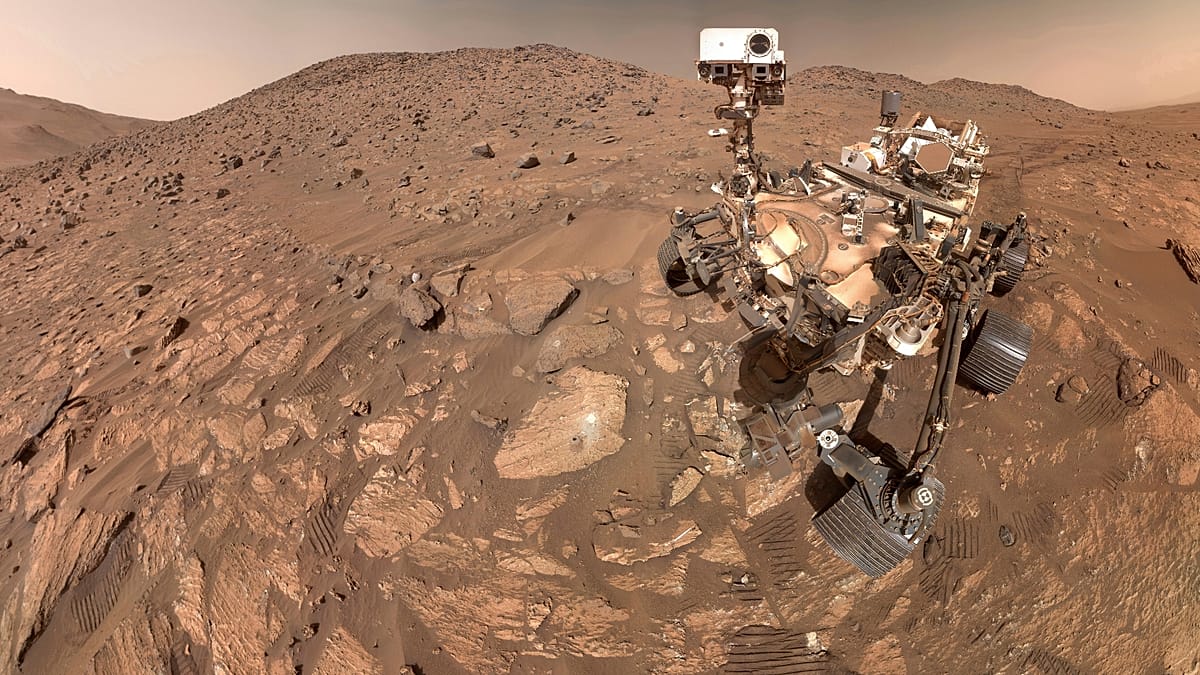
Researchers at the Hong Kong University of Science and Technology (HKUST) are making strides toward the future of Mars colonization with a groundbreaking development in 3D printing technology. As we look forward to humanity’s return to the Moon, thanks to the Artemis program, the scientific community isn’t stopping there. They are already preparing for the next big leap: establishing a human presence on Mars. Under the leadership of civil engineer Jishen Qiu, the team has crafted an innovative formula for 3D printing housing structures on the Red Planet, ingeniously combining gelatine, yeast, and regolith, the latter being the Martian soil that covers the planet’s surface.
Now, let’s dive deeper into this fascinating project. The Martian regolith is a unique material, a mix of fine dust, sand, pebbles, and rock fragments. The researchers have figured out how to utilize this local resource as a structural base, giving much-needed volume and mass to their constructions. They’ve designed their process to operate in the “local frozen climate,” effectively using it as a natural freeze-dryer. This approach saves energy and prevents the melting of minerals, which is a big deal when you’re trying to build something on another planet. During the 3D printing process, they applied low temperatures and maintained a delicate atmospheric pressure to promote the sublimation of ice into vapor, leading to the creation of a solid yet lightweight foam.
In tests conducted in simulated Martian environments, the new compound showed impressive results, resisting compression at levels comparable to lightweight concrete. This makes it an ideal candidate for constructing multi-storey, fully recyclable structures. However, before we all start dreaming of our future Martian homes, several challenges remain. For instance, will micro-organisms be able to survive in Mars’ harsh conditions? And what about the reliance on resources sent from Earth? These are significant hurdles that still need to be addressed.
Interestingly, using yeast in 3D manufacturing isn’t entirely new. The Chalmers University of Technology in Sweden has previously explored similar territory, creating a hydrogel from yeast and cellulose for biodegradable architectural components. This innovative use of food industry waste shows how we can promote circular architecture, not just on Earth but also in our future space missions.
In parallel to academic efforts, the aerospace sector is ramping up industrial-scale 3D printing for space habitats. NASA, for example, has invested about $57.2 million into the Olympus Project, which focuses on building permanent infrastructures on both the Moon and Mars. One of the exciting practical applications of these technologies is Mars Dune Alpha, a 150-square-meter habitat structure produced via 3D printing in Houston. This model has been used in the CHAPEA analogue missions, simulating human life on Mars and laying the groundwork for what could become humanity’s new frontier.
So, where does this leave us? The potential for colonizing Mars is not just a dream anymore—it’s becoming a reality, albeit with many questions left unanswered. As scientists continue to push the envelope, we can only wonder how soon we might actually see people living and thriving on the Red Planet. Will we be the generation that takes that leap?
Kaynak: Orijinal Haber