
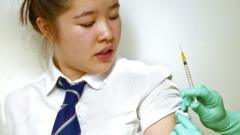
New research reveals that children vaccinated against HPV (human papillomavirus) at ages 12-13 have close to zero risk of dying from cervical cancer before reaching 30. This groundbreaking study marks the first of its kind, highlighting a significant decline in cervical cancer deaths since the vaccine was offered to school-age girls in 2008. So far in England, approximately 200 lives have been saved due to this vaccination initiative. Notably, between 2020 and 2024, there were no recorded cervical cancer deaths among women aged 20 to 24, a remarkable first over a five-year span. Normally, around 23 deaths would have been expected in this age group without vaccination.
“It’s incredible to think that a single jab can almost eliminate a particular type of cancer,” said Prof. Peter Sasieni, the lead researcher at Queen Mary University of London. Cervical cancer remains the 14th most common cancer among females in the UK, with about 3,300 diagnoses each year. HPV, which spreads through close skin-to-skin contact, is thought to be responsible for 99% of these cases. While most HPV infections resolve on their own, some can lead to abnormal cell changes and potentially cancer many years later.
The authors of the report anticipate that cervical cancer deaths will continue to drop as more individuals receive the HPV jab and as those already vaccinated age. Cancer Research UK, which funded the research, labeled these findings an “incredible milestone” but also cautioned that vaccination rates in England are currently below the recommended levels. “We know the HPV vaccine is extremely effective at stopping cervical cancer before it starts, and for the first time, these findings show it is saving lives,” stated Michelle Mitchell, the organization’s chief executive.
Alexandra Legg is a poignant example; she left school just before the HPV vaccine was introduced in England. In 2021, at the age of 30 and just as she was planning her wedding, she received a cervical cancer diagnosis. “I remember hearing the words and I just couldn’t really breathe very well,” she recalled. “I was so upset – everything went through my head, it was so hard.” Her treatment involved the removal of lymph nodes in her abdomen, but surgeons managed to preserve a small section of her cervix, giving her a chance of becoming pregnant. Just a year later, her daughter Ivy was born, with her middle name Marvella meaning “miracle.” “Those nine months were so scary because I was at such risk of losing her at any point,” Alexandra shared. She believes that her life would have been much less traumatic had she been offered the HPV vaccine and fervently encourages eligible individuals to get vaccinated. “I’m a real advocate for this vaccine, and when Ivy is old enough, she’ll be first in the queue,” she added.
Prof. Sasieni, who specializes in cancer epidemiology, described the reduction in deaths since the vaccine’s introduction as merely the “tip of the iceberg.” “As vaccinated generations grow older, we’ll see many more lives saved from cervical cancer,” he said. The report emphasizes the critical need to maintain high HPV vaccination levels to protect more people. The UK government has pledged to eliminate cervical cancer as a public health issue by 2040, yet recent data indicates that vaccination rates have dropped below recommended levels. According to the UK Health Security Agency, only 76% of girls in England were vaccinated by age 15 in 2024-25, significantly below the 90% threshold suggested by the World Health Organization (WHO) to eradicate cervical cancer.
“It’s essential that the UK Government and health systems urgently address this with targeted action to reach communities where uptake is the lowest,” Michelle Mitchell emphasized. Dr. Sharif Ismail from the UK Health Security Agency urged young people who missed their vaccinations to come forward. Despite the vaccination rollout, women aged 25 to 64 are still advised to participate in cervical screening (formerly known as smear tests). Since 2019, boys have also been receiving the HPV vaccine, which protects them against anal, penis, throat, and mouth cancers, and reduces the likelihood of spreading the virus to girls.
The Department of Health and Social Care in England stated that the study underscores the “extraordinary impact of the HPV vaccination.” “We are boosting vaccine uptake so that more young people benefit from this life-saving protection, including rolling out catch-up HPV vaccination campaigns via community pharmacies,” a spokesperson noted. HPV self-testing kits are also being dispatched to women who have not yet come forward for screening. Moreover, a catch-up clinic is being organized for young people who may have missed their routine vaccinations.
In other news, Briony May Williams, now a successful TV presenter, shared that she began stress-baking when she fell ill. Three nurses behind the initiative want women to feel empowered to have open and honest conversations about their health. New mothers have also voiced their concerns about receiving inadequate breastfeeding support when their babies were born. The vaccine for sixth formers and students starting university this September is currently being rolled out.
Kaynak: Orijinal Haber