
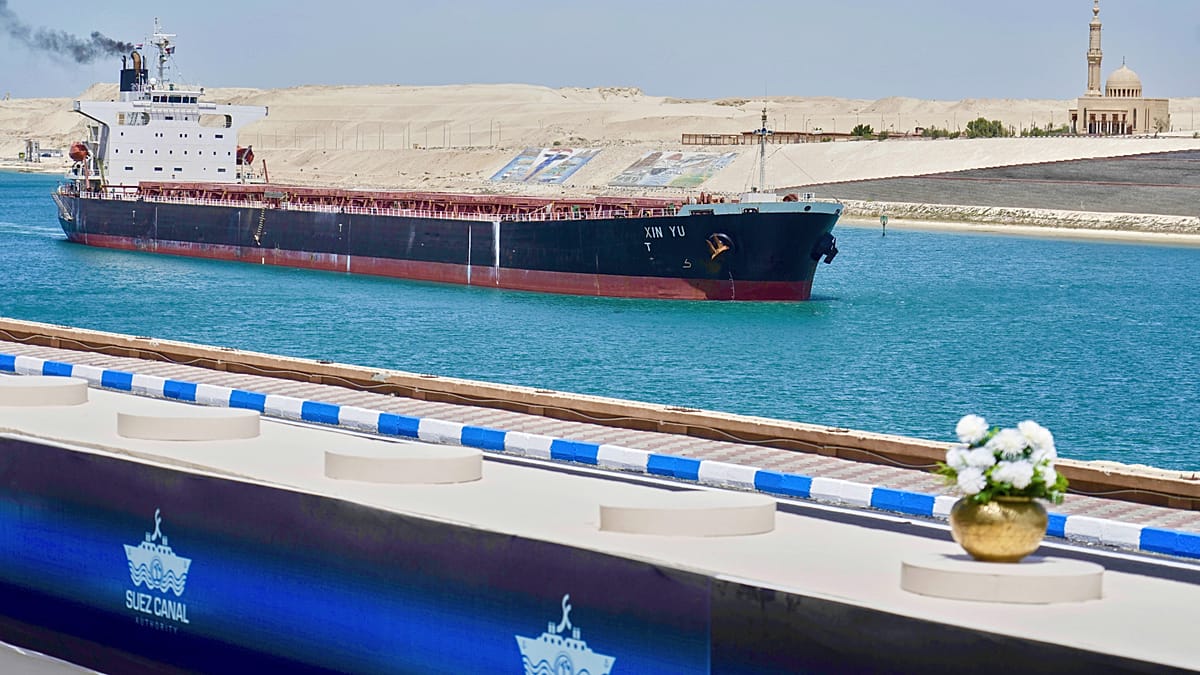
Shipping giants Maersk and Hapag-Lloyd have made a significant move by reinstating a major Asia-Europe container service through the Suez Canal, a crucial step in the gradual revival of shipping along this vital route. The AE19 service, which operates under the companies’ Gemini Cooperation, links Asia, the Mediterranean, Saudi Arabia, and Europe. Up until now, it had been taking the longer route around the Cape of Good Hope. This change was announced on Monday and took effect immediately, kicking off with the westbound journey of the Berlin Maersk. Hapag-Lloyd informed Euronews that this switch to the AE19 is expected to cut transit time by nearly four weeks compared to the lengthy journey around Africa.
The decision to return to the Suez route comes after a careful evaluation of security conditions in the Red Sea, according to Maersk. However, Hapag-Lloyd was quick to clarify that this is just a “targeted adjustment for one selected service, not a broad return to the network.” Future routing decisions will hinge on security, operational viability, and customer impacts. Interestingly, Maersk also revealed that AE19 is just one of four services it has transitioned from the Cape of Good Hope to Suez since early July, with the others being AE15, MECL, and WAF6.
But hold on! While this is good news, it doesn’t mean that all services will rush back to Suez. Nine additional services could potentially benefit from the Red Sea and Suez route but are still taking the longer path around Africa. That’s a lot of ships stuck in the slow lane… Shipping analysts caution against interpreting the return of these few services as a signal of a wider resurgence in Suez traffic. Simon Heaney, a senior manager for container research at maritime consultancy Drewry, pointed out that the pace of recovery is intricately linked to the ongoing Strait of Hormuz crisis and broader conflicts in the Middle East. “While those issues remain unresolved, we don’t foresee a meaningful return of Asia-to-Europe loops via Suez,” he emphasized.
Even if security improves, it’s unlikely that shipping companies will revert all their services to Suez in one fell swoop. Heaney noted that a gradual return is more probable, starting with routes from Europe carrying lower-value cargo. Carriers will want to be sure that hostilities won’t resume before they commit more valuable shipments to this route. Plus, there’s a commercial angle to consider. Going around Africa means needing more ships since each journey takes longer. If a lot of services switch back to Suez at the same time, those ships would be freed up just as carriers are welcoming a large influx of new vessels. “Carriers have to manage capacity wisely due to the large number of new ships being delivered,” Heaney added. “Shortening rotations en masse will cause rates to plummet.”
For European importers, this piece-meal return to Suez means that the advantages are unlikely to come all at once. A few restored services might provide shorter journeys on select routes, but don’t expect normal transit times across the entire network to bounce back immediately. The Suez Canal is the quickest maritime link between Asia and Europe, bypassing the much longer trip around the Cape of Good Hope. The detours have racked up time and fuel costs for voyages, while also depriving Egypt of a crucial source of foreign currency. The Suez Canal Authority has been persistent in its efforts to lure shipping companies back. In June, Admiral Osama Rabiee, the chairman of the authority, mentioned that shorter transit times and operational savings were key factors attracting some of the world’s largest container vessels back through the canal.
This comeback was highlighted when the CMA CGM Vendôme, capable of carrying 24,000 twenty-foot containers, passed through Suez on a route between Asia and northwestern Europe. This was the first southbound transit of the FAL 3 service through Suez since January. According to the authority, vessels from France’s CMA CGM made 104 trips through the canal between January and May, carrying a total tonnage of 12.5 million tonnes. While the return of several services hints at a revival of traffic through Suez, both Hapag-Lloyd and Drewry caution that AE19 does not yet herald a broader return.
Görünüşe göre, gelişmeler devam edecek… Bakalım bundan sonra ne olacak?
Kaynak: Orijinal Haber