
Ollie Priestley is diving deep into a unique apprenticeship as a heritage vehicle technician. At just 29 years old, he’s not just tinkering away at any standard mechanical job. Instead, at the renowned restoration business Tolman, based in Leicestershire, he’s getting hands-on experience with the kind of skills that blend old-world craftsmanship with cutting-edge technology. Imagine this: he recently fabricated a gearbox mount for a classic BMW! Now that’s not your everyday car repair…
Chris Tolman, the founder of Tolman, explains how Ollie’s training is a game changer. Unlike apprentices in typical car dealerships who are relying more on digital tools and becoming mere “fitters”, Ollie is learning to master both traditional skills and modern techniques. This three-year apprenticeship, introduced back in 2018 through the Heritage Skills Academy in Bicester, is designed to equip students with essential skills like welding and glazing alongside digital tools like 3D printing and CAD. That’s right, it’s a level three apprenticeship that’s equivalent to three A-levels, making it a serious qualification for those in the field.
What’s fascinating is how this new approach is addressing a gap in the industry. Many modern engineers transitioning into the heritage sector often lack the basic engineering principles needed to diagnose and repair vehicle systems without a computer’s assistance. Pitchforth points out that today’s apprentices are learning to balance the practical skills of making with the digital skills of understanding production processes. However, Iveson warns that if the training becomes too focused, apprentices might miss out on vital knowledge about materials, tooling, and quality processes.
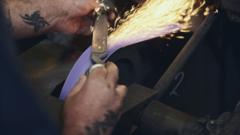
Just a stone’s throw away from FourJaw in the city center lies Ernest Wright, a scissor-maker that’s been around since 1902. They still craft scissors and shears by hand, in small batches, and you can bet they’re not just relying on machines. In fact, they’ve recently started testing metal printing, allowing them to create just six pairs of scissors at a time—how cool is that? “If we want to change things, we don’t have to do it on 6,000 pairs,” says Nurcombe, 21, adding that there’s still no real opportunity for technology to replace the skilled hands that work there.
Meanwhile, in Sheffield, Platts & Nisbett, makers of surgical instruments, have embraced technology as well. Their process now includes CNC cutting at the initial stage, with the final touches done by skilled hands. Each instrument gets a laser tag, ensuring it can be traced back to the original maker, no matter where it ends up. But the challenge remains: finding the next generation of craftsmen who prefer working with their hands rather than sitting in front of a computer screen.
This blend of old and new, tradition and innovation, is truly reshaping the landscape of apprenticeships. As we move forward, one has to wonder—how will these evolving skills influence the future of craftsmanship? Will we see a revival of traditional skills, or will technology continue to dominate the scene?
Kaynak: Orijinal Haber