
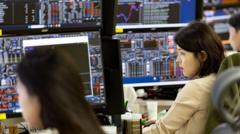
South Korea’s stock market was hit hard on Monday, forcing a halt in trading for 20 minutes after the Kospi index plummeted nearly 9% just minutes after the open. This was the third time this year that the circuit breaker mechanism was triggered, aimed at preventing panic selling in the market. Over in Japan, the Nikkei 225 index also took a significant hit, sliding about 4.5%, marking its steepest decline in three months as major tech shares took a nosedive.
The market’s downward spiral coincided with rising oil prices, a situation that only added to inflation concerns. This spike in oil prices came after Iran and Israel exchanged strikes for the first time since a ceasefire was agreed upon back in April. Traders are now nervously watching what they describe as a “messy mix” of market shocks, largely tied to the tech sector and exacerbated by the rising costs of energy, according to Charu Chanana, the chief investment strategist at Saxo.
In recent weeks, tech stocks were on a strong run, but now investors are “repositioning” amid fears that the surge in investments related to artificial intelligence might be overblown. It’s worth noting that markets like the Kospi and Nikkei are particularly vulnerable to these kinds of shocks due to their heavy reliance on tech stocks. The losses in Asia came on the heels of a sharp drop on Wall Street, where the Nasdaq saw a decline of about 4% on Friday, its largest drop in over a year.
This decline was partly fueled by concerns over a potential hike in US interest rates, triggered by a lower-than-expected unemployment rate in April and persistently high inflation linked to ongoing conflicts in the Middle East. After the circuit breaker was lifted, trading resumed in South Korea, but the Kospi index remained down by roughly 7.9% by early afternoon. Major South Korean tech firms, including chipmakers Samsung and SK Hynix, faced significant losses as panic spread.
South Korean President Lee Jae-myung remarked that while the market is expected to be volatile, he believes domestic shares are still “slightly undervalued.” The tech-heavy Kospi had seen substantial gains recently due to a surge of investments in the nation’s tech sector. Investors are now eager for tangible evidence that AI demand is leading to “real revenue,” with Chanana emphasizing that “the burden of proof has gone up.”
Other Asian stock exchanges weren’t spared either; the Hang Seng Index and the Shanghai Composite also reported declines on Monday. Taiwan’s Taiex plunged sharply too, especially after shares of semiconductor giant TSMC fell by 3%. This chipmaker is a crucial supplier to Nvidia, whose CEO, Jensen Huang, suggested that the recent downturn in tech stocks might offer a prime buying opportunity for savvy investors.
Meanwhile, global oil prices are also making headlines. The benchmark Brent crude surged by 4.6% to $97.34 a barrel, and US-traded crude jumped by 4.3% to $94.40 after the strikes between Iran and Israel. Tehran has warned that these strikes could be just the beginning of a week filled with military actions, citing a “repeated violation” of a ceasefire established on April 17 between the US, Israel, and Iran. In retaliation, Israel has targeted military sites in Iran, despite US President Donald Trump advising against escalation.
Now, it’s too early to predict whether these strikes will lead to a full-blown escalation of the conflict, but traders are clearly pricing in the risks to global oil markets, said Associate Professor Jiajia Yang from James Cook University in Australia. The ongoing military actions reveal that many political issues remain unresolved, and unless diplomatic efforts bear fruit, oil prices are expected to remain volatile. Since the US and Israel launched strikes on Iran on February 28, oil prices have seen wild fluctuations, and they’ve hovered around the $95 mark recently as traders consider the long-term implications of the conflict on global energy flows.
As the situation continues to evolve, the war has already disrupted the flow of oil and gas shipments from the Gulf, especially with Iran threatening to strike vessels attempting to navigate the critical Strait of Hormuz trade route in retaliation for US-Israeli attacks. It’s a tricky time for markets across the board… What’s next for investors?
Kaynak: Orijinal Haber