
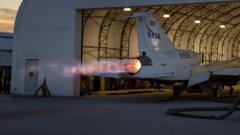
The X-59 is making waves in the aviation industry, and it’s not just because of its peculiar design. This aircraft, with its long nose, is engineered to minimize the sonic boom, transforming what would typically be a disruptive noise into mere background thumps. Think about it: the X-59 could redefine air travel as we know it. With its elongated snout, it aims to flatten those supersonic booms that have long been an annoyance for those living near flight paths. Imagine flying faster than sound without waking up the entire neighborhood… how cool is that?
The X-59’s history is equally impressive. NASA has been dabbling in experimental X-planes for quite some time, and the X-59 is just the latest chapter. Coen, one of the project’s key figures, mentions their strategy involves setting small, achievable goals. They’re working meticulously, crafting an airframe designed specifically for these tasks. “We want to figure out what level of boom is acceptable to people on a regular basis,” he explains, hinting that the sound of his creation might be likened to “a car door being closed across the street.” It’s fascinating stuff, but it raises a crucial question: do we really need these X-planes when drones are on the rise?
Now, hold on a second. While many are jumping on the drone bandwagon, Coen points out that going crewless isn’t always the cheaper or simpler option. Sure, we could remove the pilot, but that introduces a whole new set of challenges. Certifying an uncrewed jet to zoom over urban areas isn’t just a walk in the park—it’s complicated and costly. Plus, the X-59 had to be sizeable enough to resemble a real airliner breaking the sound barrier, which, by the way, also necessitated a cockpit. So, it’s not as straightforward as it seems.
And let’s not forget the X-48, another NASA experiment that took to the skies back in 2007. This scaled-down model blended wing and fuselage into a single lifting body. The X-48 was small—only 20 feet across—allowing it to stay within budget. But as Guy Gratton, a professor at Cranfield University, passionately argues, we can’t dismiss the importance of human pilots in the equation. “If you want to carry people, you can’t take shortcuts,” he insists. “You lose a huge amount without pilots.” It’s a strong point, and many in the aerospace community echo this sentiment, emphasizing that the human touch in aviation is as crucial now as it ever was.
Looking ahead, Coen suggests that future X-planes could very well be uncrewed. Yet, there’s a caveat: “Unless the technology we have changes.” The human element can’t be overlooked, especially when it comes to testing. It often takes four times as many personnel on the ground to ensure a drone’s safe operation compared to a crewed flight. The Experimental Aircraft Program (EAP), which took flight from Lancashire in 1986, serves as a reminder of the critical systems tested for fighter jets like the Typhoon. It’s been nearly forty years, but the legacy of human pilots continues to play a part in modern aviation.
So, what does this mean for the future? As nations, including Italy and Japan, commit to joint efforts like GCAP, it’s clear that the aerospace industry is serious about innovation. But with the rise of artificial intelligence, one has to wonder—what’s next for X-planes and drones? Will we see a world where crewed aircraft are a relic of the past, or will the need for human oversight ensure pilots remain at the forefront of aviation? It’s a thrilling time to be watching this space…
Kaynak: Orijinal Haber