
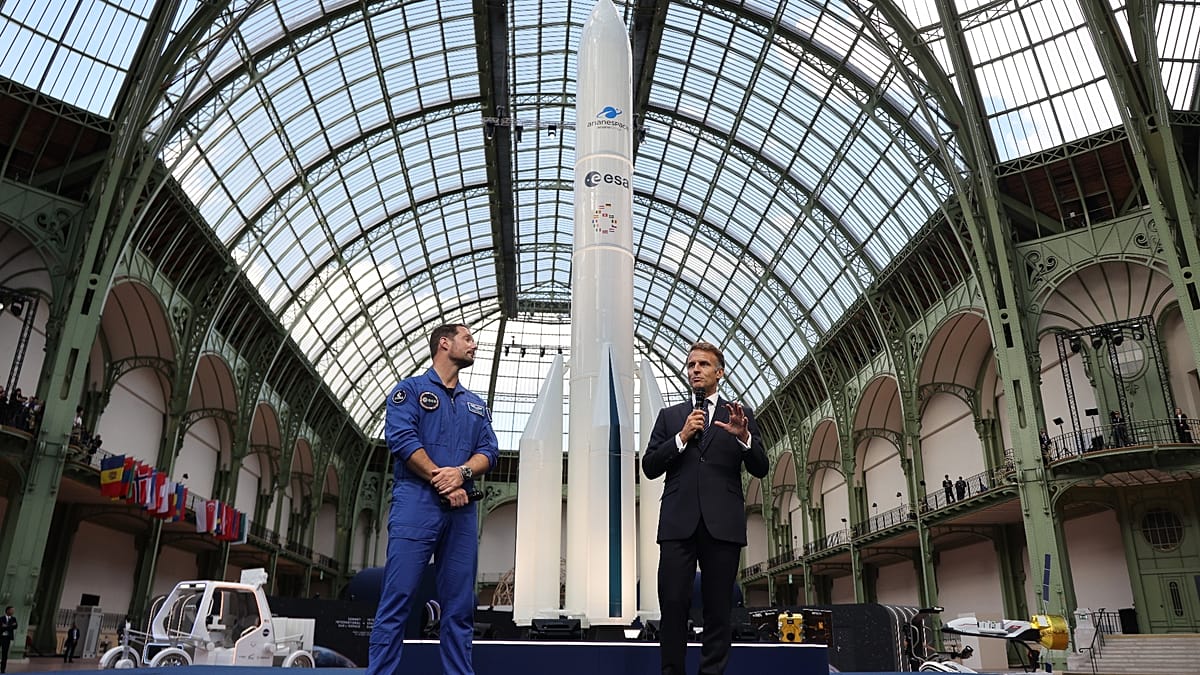
French President Emmanuel Macron and European Commission President Ursula von der Leyen have made a strong call for Europe to ramp up its space industry during the ongoing international space summit, held at the Grand Palais in Paris, co-hosted by France and Germany. On the second day of the summit, Macron didn’t hold back, labeling Europe’s space sector as “fragile” and stressing the urgent need to strengthen its capabilities. He highlighted that “outer space remains the only major global commons that is not subject to regulations that match the stakes,” emphasizing that “shared governance is necessary to address these challenges.”
As the summit progresses, Macron announced that over 51 deals are expected to be signed, with investments reaching a staggering €20 billion. He laid out ambitious plans for the future, saying, “In two years’ time, the first European lunar lander, Argonaut, will land on the Moon’s surface.” This bold statement underscores Europe’s intentions to assert its presence in space, particularly against the backdrop of ongoing geopolitical tensions, including the war in Ukraine. He pointed out that Europe is working to reduce its historical dependence on the US in the space sector.
Interestingly, before the summit kicked off, reports surfaced that several US companies had pulled out of the event, allegedly due to pressure from Washington regarding support for “EU policy positions.” A spokesperson for France noted that it’s hard not to link this withdrawal to the rumors circulating in the press. This is a clear indication of the shifting dynamics in international space cooperation, as Europe seeks to carve out its own path in the cosmos.
Historically, Europe has invested only 0.07% of its GDP into space programs, while the US has poured in 0.24%. However, 2025 is set to be a transformative year, as the European Space Agency (ESA) has approved a record-breaking €22.3 billion budget for its three-year funding cycle from 2026 to 2028, including €35 billion earmarked for security and defense in space, as von der Leyen pointed out. She also highlighted the importance of the IRIS² project, which aims to deploy over 350 satellites to bolster Europe’s capabilities in space.
During the summit, Macron, along with Joseph Aschbacher, the Director of the European Space Agency, connected live with astronaut Sophie Adenot, who is currently on a nine-month mission aboard the International Space Station (ISS) as part of the εpsilon mission. This connection showcased the human element of space exploration and the collaborative spirit of Europe’s aspirations in this frontier.
So, as we look ahead, the question remains: can Europe truly unite and build a robust space industry capable of standing on its own? Or will old dependencies and geopolitical pressures continue to shape its journey? The developments at this summit will undoubtedly be pivotal in answering these questions.
Kaynak: Orijinal Haber