
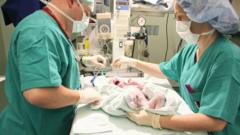
A quarter of all babies born in England are now arriving into the world via emergency caesarean sections, according to a recent analysis by the BBC. This marks a staggering increase over the last five years, with unplanned surgeries climbing by eight percentage points. Meanwhile, the rate of vaginal births without the aid of instruments has significantly dropped, plummeting from over half of all deliveries to just 43%. It seems like a total transformation in the way women give birth in England, a change that the director of the National Perinatal Epidemiology Unit, Prof Marian Knight, believes is unprecedented compared to other European countries.
But here’s the kicker: The NHS doesn’t release data on why these emergency C-sections are happening, which leaves experts scratching their heads over the reasons behind this surge. Some insiders worry that a growing culture of fear in maternity wards, both among medical staff and expectant mothers, is pushing the number of emergency procedures higher. The Royal College of Obstetricians and Gynaecologists has noted that the strain on healthcare staff and surgical facilities has left the system gasping for air, struggling to keep up with the mounting demand for these operations. NHS England insists that decisions are made based on individual circumstances and clinical guidance to ensure the safest birthing method for both mothers and babies.
So what’s the deal with these emergency C-sections? They can range from life-threatening situations for either the mother or her baby to instances where labor isn’t progressing as it should. BBC Verify has been on the case, tracking birth trends and revealing that while vaginal deliveries remain the most common method, their prevalence has seen a noticeable drop—from 53% to 43%. As for planned caesareans, they now account for 20% of births, while emergency C-sections have seen a steady rise, soaring from 18% to 26%.
And it’s not just England that’s affected. Emergency C-section rates in Scotland are at 22%, 20% in Wales, and 16% in Northern Ireland. In a comparative study of 42 countries, Prof. Knight’s unit found that England has jumped from 14th to 9th in terms of C-section rates in just five years, while most other countries aren’t experiencing such steep increases. Despite this troubling trend, the rates of stillbirths and neonatal deaths have remained relatively stable.
Prof. Shakila Thangaratinam from the University of Liverpool has raised concerns about this increase, especially since it hasn’t been accompanied by a decrease in stillbirths or maternal complications. She pointed out that the reasons for this spike are largely unknown, emphasizing the need for better data reporting to understand the situation fully. Interestingly, she also wants to look into how race plays a role in this phenomenon. While the national average for emergency C-sections is one in four births, that figure rises to about one in three for black and Asian mothers.
As if that wasn’t complicated enough, Prof. Knight believes factors such as age, obesity, and pre-existing health issues might be driving the increase as well. But let’s not forget the huge impact of recent maternity scandals that have left many healthcare workers—and mothers—feeling anxious. For years, the norm was to keep C-section rates low, but those targets were scrapped in 2022. With reports of tragic outcomes in cases from Morecambe Bay to East Kent, ongoing investigations in Nottingham and Leeds are also raising alarms.
Prof. Knight highlights that the fear among women, families, and staff could be influencing the decision to choose or recommend C-sections more often. One healthcare professional candidly remarked that nobody wants to be involved in the next scandal. Legal claims against the NHS for maternity-related issues have risen by 11% over the past five years, often questioning why a C-section wasn’t performed or wasn’t conducted sooner. It’s worth noting that doctors and midwives rarely face criticism for opting for an early C-section.
At Northwick Park Hospital in London, the BBC spent two days observing the maternity unit and met Khushi, an 18-year-old new mother who underwent an emergency C-section because her baby’s heart rate kept dipping during labor, classifying it as category one—the most urgent kind. She expressed her feelings of confusion and fear, recalling that she had no idea what she was getting into. “It was my first ever surgery. Just the thought of being open on a table still feels so surreal and so unbelievable,” she said. Now, at home with her baby, Aarav, she faces a six-week recovery from major surgery, but she insists the mental trauma is even tougher to cope with.
Dr. Alison Wright, the president of the Royal College of Obstetricians and Gynaecologists, has been delivering babies for 35 years and is deeply concerned about how services will adapt to accommodate the rising number of emergency C-sections. Many maternity units are already stretched thin when it comes to dedicated obstetric theaters. “If we don’t invest in our workforce and in our operating theater capacity, we may find ourselves in a situation where we can’t perform the emergency caesareans we desperately need,” she stated.
According to health economist Prof. Ed Wilson from the University of Exeter, the financial implications are significant as well. A routine vaginal delivery can cost nearly £4,800, while a planned caesarean runs about £6,000. But emergency C-sections? Those can skyrocket to nearly £9,000. An NHS spokesperson has reiterated that the rise in emergency C-sections is influenced by numerous factors, but maintaining the safety and wellbeing of mothers and babies is always their top priority.
The Department of Health and Social Care has committed to enhancing maternity and neonatal safety, with Health Secretary James Murray leading a national maternity task force. Meanwhile, the community is left hoping that these ongoing reviews and investigations will lead to real improvements in maternity care.
Kaynak: Orijinal Haber
Acil sezaryenler çoğalınca doğum korkulu rüya gibi olmuş. Herhalde bebekler de “hadi ama, acelemiz ne?” diye sormuş olmalı!