
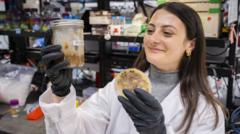
Vayu Hill-Maini’s lab at Stanford University has made waves by creating a cheese-like product from food waste. Yes, you heard that right! This innovative bioengineer is diving deep into the world of fermentation, using fungi to turn what would typically be discarded into something delicious. “One of the most amazing things that we found recently is that we could take waste and add a few other ingredients in a fungal fermentation and create this delicious cheese that is like a Pecorino or Parmigiano,” he shares excitedly.
Now, let’s break it down. Fermentation is this biological magic trick where organisms convert carbohydrates, like starch or sugar, into other substances, such as alcohol, without needing oxygen. Most of us associate fermentation with baking or brewing, where yeast works its wonders on sugar. But hold on! It’s not just flour or barley that can do the job. There’s a whole slew of materials that can kickstart fermentation, scientifically known as substrates.
With cutting-edge biotech tools, companies are stepping up to transform food industry by-products that usually end up in the trash into valuable resources. Take for instance UK-based Fermtech. They’re turning cocoa shells, those often-overlooked leftovers, into a cocoa powder substitute. “If you were to sniff a bag of cocoa shells, you would be really struck by the intense chocolatey nature of it,” says Andy Clayton, Fermtech’s CEO. It’s a crying shame that these by-products are often composted or burnt, rather than harnessed by microorganisms that can break down the tough bits of the plant and make them digestible for humans while keeping those rich flavors intact.
And you know what? Tapping into a broader range of substrates can save cash, help our planet, and expand flavor profiles. “We’re kind of like flavour miners,” Clayton adds. Now, let’s talk about peas. Did you know that protein makes up about a quarter of a pea? That means the other three-quarters are just sitting there! According to Bosco Emparanza, the CEO of Spain’s MOA Foodtech, that leftover part is “a perfect substrate for fermentation.” His company is gathering data on environmental conditions and available substrates while sequencing the genomes of microorganisms suited for the food industry.
And get this: they’ve trained an AI to figure out the best combinations of substrates and microorganisms to maximize yields. Emparanza is pretty amazed at how fast this AI-driven fermentation design has evolved. “When we started the company, we were able to develop one bioprocess in two weeks,” he recalls. “Nowadays, the platform can develop 300 bioprocesses per hour.”
Thanks to this groundbreaking tech, MOA Foodtech is uncovering the best microorganisms to take advantage of leftover starch and fiber from the pea protein industry. Instead of being sold off cheap for animal feed or tossed aside, these by-products are getting a second chance in the human food chain. Over in Germany, MicroHarvest has developed a super-fast fermentation process using by-products from the sugar industry, like molasses, which many folks don’t even consume in Germany. Rather than letting sugar makers offload this to farmers for cow feed, MicroHarvest is teaming up with them and pet food producers to turn side streams into premium pet food.
Katelijne Bekers, the CEO and co-founder of MicroHarvest, describes their cat snack, Vegcat, as having an umami taste without the bitterness some plant-based proteins have. Meanwhile, Singapore’s Mottainai Food Tech is on a mission to employ unconventional and underappreciated ingredients that are not just nutritious but also widely accessible throughout Asia. The term “mottainai” comes from Japanese, expressing the sorrow of waste—think “waste not, want not.” They’ve crafted a meat substitute called Jiro Meat from okara, the soy pulp often tossed out after making tofu and soymilk. They’re also dabbling in a plant-based tuna project, experimenting with various microorganisms to minimize off-flavors while maximizing those sought-after flavor compounds like umami or sweetness.
Singapore has a very supportive atmosphere for such food experiments. “In five years’ time, we hope to be able to have a wide range of ingredients,” says Daryl Pek, a co-founder of Mottainai Food Tech, as they work with their fermentation platform. Back in Stanford, Hill-Maini’s lab is pioneering precision fermentation. This involves genetically engineering microorganisms, like molds, to produce specific materials through fermentation. Precision fermentation can fine-tune the aesthetics, aroma, flavor, and even digestibility of food.
Hill-Maini points out that some waste products are rich in cellulose, which humans can’t digest. But fungi can break down cellulose and turn it into protein as they grow. “They become kind of a bioconversion machine where they can remove those complicated molecules that the human gut cannot digest and convert them into more digestible substances,” he explains. Hill-Maini is keen on inspiring others to rethink food waste, but he’s not keeping this work locked away in the lab. They have a chef in residence and a culinary innovation kitchen to ensure that their food experiments are appealing to potential consumers.
Regarding the new Pecorino-like cheese, while the lab used a Neurospora mold, the specific waste they used as a substrate remains under wraps until they release their research paper. But Hill-Maini can’t contain his excitement about their creation. “You can grate it, it’s salty, it has a nice texture, it can be added to pasta. And it’s just really cool to see… the fermentation can help it become delicious.”
As we witness this remarkable shift in how we view food waste, one has to wonder—what other culinary surprises lie in the shadows of our discarded scraps?
Kaynak: Orijinal Haber