Andy Burnham has boldly announced his intention to enter any potential Labour leadership contest if he secures victory in the Makerfield by-election
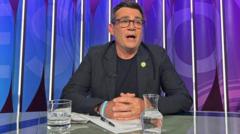
Andy Burnham has boldly announced his intention to enter any potential Labour leadership contest if he secures victory in the Makerfield by-election set for June 18. The Mayor of Greater Manchester laid out his aspirations while sharing the stage with four other candidates during a special BBC Question Time event in the constituency. It’s a high-stakes game, folks, and the atmosphere is charged with anticipation!
Reform UK candidate Robert Kenyon chimed in, emphasizing the urgent need for a significant shift away from career politicians. He warned against the notion of using Makerfield as just a “stepping stone” for greater ambitions. Meanwhile, Prime Minister Sir Keir Starmer has faced mounting pressure from some Labour MPs to resign following disappointing election results last month, but no formal challenge to his position has been initiated just yet. A spokesperson from No 10 stated firmly that “the prime minister will not walk away from the mandate he was given just two years ago to build a stronger, fairer Britain.”
This by-election was called after the former Labour MP, Josh Simons, stepped down, a decision he claims was to pave the way for Burnham to run for Parliament and potentially mount a leadership challenge. The upcoming vote in Makerfield is shaping up to be a contest primarily between Burnham and Kenyon, a local plumber and councillor. When asked about the restoration of public trust in politicians, Burnham took shots at the “point-scoring before problem-solving” mentality prevalent in Westminster, all while being pressed about his own leadership ambitions.
He stated, “I can’t do anything unless I’m lucky enough to get the support of people here. But if I get your support, I would seek to represent you at the highest possible level and give this constituency maximum power and influence.” He also mentioned that Wes Streeting seems to have already thrown his hat in the ring for a leadership contest, indicating his desire to join the fray if the opportunity arises. To kickstart a leadership contest, any challenger must be an MP and have the endorsement of 81 Labour MPs. Streeting has confirmed his candidacy and has urged supporters to back Burnham in Makerfield, expressing a desire for a “proper contest with the best candidates on the field.”
Kenyon didn’t hold back, criticizing Burnham’s record as mayor, noting that while Manchester “thrives,” Wigan is “struggling to survive.” He added, “We’ve been left behind,” stressing the need for “normal people in politics,” those who genuinely care for the area, live there, and are not merely using it as a launching pad for their ambitions. Conservative candidate Michael Winstanley questioned Burnham’s motives for returning to Parliament after previously promising to serve his current term as mayor, expressing his “disgust” and “sadness” over the by-election being forced upon voters. He declared, “We will get rid of Keir Starmer whichever politician is elected in this by-election, and if you vote for me, it’ll speed it up straightaway.”
In response, Burnham stated, “You cannot control events in politics,” while highlighting Labour’s setbacks against Reform in recent council elections in the area. Green Party candidate Sarah Wakefield called for “serious conversations” about contributing to a better future for children, tackling the climate crisis, revitalizing high streets, and ensuring funds return to towns and villages. Liberal Democrat candidate Jake Austin remarked that this by-election feels like “an election for a potential future prime minister via the backdoor,” emphasizing that this isn’t the right way to conduct politics.
In an unexpected twist during the debate, Kenyon faced questions about his previous online remarks regarding women and abortion, firmly stating he “won’t accept” being labeled sexist. He highlighted his upbringing, saying he was “brought up by women” and has “nothing but respect for women,” admitting, “I’ve made mistakes, I’ve said things years ago that I wouldn’t say now.”
Candidates were also pressed on the tragic murder of 18-year-old Henry Nowak. Bodycam footage revealed police placing the Southampton University student in handcuffs as he lay dying, after his murderer, Vickrum Digwa, falsely claimed he was the victim of a racist attack. Digwa, 23, received a life sentence for murder, with a minimum of 21 years behind bars. Nowak was stabbed with what Digwa claimed was a ceremonial knife, part of his Sikh faith. Burnham, when asked about supporting a ban on carrying knives for religious reasons, stated that it “needs to be looked at,” albeit requiring careful deliberation. Protests erupted in Southampton on Tuesday night following the release of the bodycam footage. Kenyon remarked that “violence is never the answer,” arguing that the situation reveals a “two-tier policing system.”
As the political landscape shifts, one thing is certain: the upcoming by-election in Makerfield will be closely watched, with many wondering where these candidates’ journeys will lead them next. Will Burnham’s ambition pay off? Time will tell…
Kaynak: Orijinal Haber