
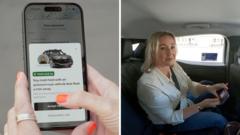
BBC’s Zoe Kleinman Takes a Ride in London’s First Self-Driving Uber!

Customers in London can now travel in the UK’s first self-driving Uber, and Zoe Kleinman, the BBC journalist, was the first to experience this futu

Customers in London can now travel in the UK’s first self-driving Uber, and Zoe Kleinman, the BBC journalist, was the first to experience this futuristic ride. The excitement in the air was palpable as she hailed the autonomous vehicle, marking a milestone in the city’s transportation landscape. Imagine cruising through the bustling streets of London without a driver at the wheel—sounds like sci-fi, right? But here we are, living in the future!

Kleinman jumped into the sleek vehicle, her heart racing with a mix of curiosity and apprehension. As the car smoothly pulled away, she shared her thoughts on the experience. “It’s incredible to see how far technology has come,” she said, eyes wide with wonder as the car navigated through traffic. This ride wasn’t just about getting from point A to point B; it was a glimpse into a new era of transport.

Now, let’s talk about the details. The self-driving Uber is equipped with advanced sensors and AI technology, allowing it to understand its surroundings and make real-time decisions. It’s like having a tiny computer on wheels, folks! Kleinman noted how the car handled the busy streets, stopping at traffic lights and even yielding to pedestrians. “It’s eerie, to be honest,” she remarked. “But also thrilling!”

Of course, with all this new tech, there’s a sprinkle of skepticism among the public. Many are wondering if these self-driving cars are truly safe. After all, trust doesn’t come easy, especially when you’re used to someone sitting behind the wheel. “What if something goes wrong?” people ask. But Kleinman reassured viewers, “The vehicle is designed to prioritize safety above all. It’s rigorously tested before hitting the streets.”

Another point of discussion is the impact of self-driving cars on jobs. Will taxi drivers be out of work? It’s a concern that looms over this innovation. However, proponents argue that this technology could lead to new jobs in tech and maintenance. “It’s a double-edged sword,” Kleinman noted, highlighting the ongoing debate about the future of work in a rapidly changing world.

As the ride came to an end, Kleinman expressed a mix of relief and excitement. “I did it! I survived a self-driving Uber!” she exclaimed. It’s a ride she won’t soon forget, and it leaves us all wondering—what’s next? Are we ready to embrace a world where our cars drive us around, or is there still a long way to go before we fully trust the machines?

Bakalım bundan sonra ne olacak? Gelişmeleri takip ediyoruz…

Kaynak: Orijinal Haber

Police Under Fire for Major Failures in Simon Levy Case: Victims Encouraged to Speak Up

Police in London are urgently calling for more victims of Simon Levy to step forward after a damning review highlighted a “litany of failures” in ha

Police in London are urgently calling for more victims of Simon Levy to step forward after a damning review highlighted a “litany of failures” in handling his case. The shocking revelations come as London’s victims’ commissioner stated that the police’s failure to monitor Levy effectively allowed him to continue his violent spree. This isn’t just about one man’s actions; it sends chills down the spine when you consider how public services can sometimes let dangerous individuals roam free, emboldening them to commit further crimes.

Levy has been linked to at least 10 assaults on women using public transport, specifically targeting busy carriages to carry out his attacks. The British Transport Police (BTP) is actively seeking more victims, emphasizing that no additional victims have been identified at this point, but they strongly encourage anyone affected to come forward. It’s a call to action for those who might have felt too scared or ashamed to speak up before.

The gravity of Levy’s crimes is staggering. He was found guilty of murdering two women, Sheryl Wilkins, aged 39, and Carmenza Valencia-Trujillo, 53. What’s even more disturbing is that he was out on bail and under police surveillance when he committed a horrific rape in January 2025. Just months later, he would go on to commit murder again. His reign of terror culminated with his conviction earlier this year for groping 10 women on the Tube, with an 11th case occurring while he was incarcerated. The offenses on the Tube took place from October 2023 to May 2025, and let’s not forget that he had been previously convicted for sexually assaulting two women back in 2018.

As for the police, two officers have been reassigned due to their “incompetence” in managing the investigations surrounding Levy, acknowledging that their actions fell short of the standards expected by victims and the public. This is a serious concern—how can we trust the very institutions meant to protect us when they fail so dramatically? The victims’ commissioner was candid in her assessment, stating that “a catalogue of disasters” led to these tragic murders. She pointed out that there were numerous “precursor offenses” that should have raised red flags, allowing police to intervene before it was too late. It’s a classic case of the system failing the very people it is supposed to safeguard.

The public is understandably outraged. How many more lives could have been spared if the pieces had been connected? “Safety should always come first,” the commissioner remarked on BBC Radio 4’s Today programme, emphasizing that in cases like this, the dots often aren’t connected until it’s far too late. It raises an unsettling question: how many more Simon Levys are out there, slipping through the cracks of a system that seems to struggle to keep up?

As the dust settles on this harrowing case, the police are hoping that those affected will find the courage to come forward, no matter how long it’s been. The fight for justice is ongoing, and it remains to be seen how the authorities will respond moving forward. Will this lead to systematic changes, or will it be business as usual? Only time will tell, but one thing is clear: the call for victims to speak up is louder than ever.

Kaynak: Orijinal Haber

Teen Hackers Behind TfL Cyber-Attack Sentenced to Over Five Years in Prison

Two young men, Owen Flowers, 18, from Walsall, and Thalha Jubair, 20, from east London, have been sentenced to five years and six months in prison f

Two young men, Owen Flowers, 18, from Walsall, and Thalha Jubair, 20, from east London, have been sentenced to five years and six months in prison for a cyber-attack that brought Transport For London (TfL) to its knees when they were just teenagers. These two were part of a group known as Scattered Spider, a collective of computer-obsessed loners, who pleaded guilty back in June for their roles in this audacious act from 2024. The attack severely disrupted TfL’s cyber security, and the implications of their actions were staggering.

Back in 2024, Flowers was just 17 and Jubair was 18 when they managed to hack into the database of individuals holding Oyster cards, the travel cards widely used across London. They didn’t just stop at accessing the database; they searched for personal details of London’s celebrities and even tried to get their hands on banking information. Can you imagine? They were joking about their exploits, clearly showing that they took this whole thing lightly. The group they were part of has been linked to numerous other attacks, including those on big-name retailers like Marks and Spencer and Co-op.

In a two-year spree, many young men and boys have faced arrest for similar Scattered Spider hacks across various countries, including the UK, US, Spain, and Finland. The TfL hack was particularly egregious, with millions of customer details stolen in a well-planned attack that began on a Saturday night, a strategic choice to avoid detection by staff. The BBC revealed that the compromised database is still being traded among criminal groups, with personal details of up to 10 million TfL customers floating around in the dark web. Talk about a massive breach!

As for how they pulled this off, it was a classic case of social engineering. Jubair and Flowers tricked a help desk worker into resetting the password of an employee they were impersonating. TfL was alerted to the breach by the National Crime Agency (NCA) and scrambled to kick the hackers out, but not before they had already accessed the data of countless individuals. The transport authority stated that, had it not been for their IT team’s swift action in logging out all staff and disconnecting their systems from the internet, the hack could’ve led to widespread chaos.

The repercussions were significant. A total of 148 technology systems became inoperable, significantly disrupting services, including Dial-a-Ride, which is crucial for disabled and vulnerable Londoners. TfL estimated the official impact of the hack to be around £29 million, with an additional £10 million in lost income. It’s not just numbers; it’s lives affected, services disrupted, and trust eroded.

In court, it was revealed that both men were loners, spending most of their days online, often unsupervised. Judge Mr. Justice Turner took their youth and autism diagnoses into consideration during sentencing, reflecting on the broader societal issues at play. Flowers reportedly rarely left his house, spending hours in his bedroom glued to his computer screen. His journey into the world of cyber crime began with a cease-and-desist order for minor offenses back in 2023, shortly after he turned 16. Just a few months later, he moved on to more serious cyber offenses, leading to his arrest in September 2024.

Footage of his arrest shows him laughing as authorities took him into custody, a stark contrast to the serious nature of his crimes. During the raid, investigators caught him in the act of hacking two US healthcare providers, with messages revealing his flippant attitude towards the potential consequences of his actions. It’s chilling to think about the impact his actions could have had on vulnerable individuals.

Experts are now calling for policymakers to view this issue as a violent youth gang problem, highlighting a culture that idolizes the destruction of society and the maximization of victim harm. It’s a sobering thought as we consider the influence of the online world on young people today.

Will we see more cases like this in the future? It’s a question that lingers as we try to navigate the complexities of youth and technology in a rapidly changing world.

Kaynak: Orijinal Haber

Young Hackers Behind TfL Cyber Attack Had Long Criminal Histories

Two young men, Owen Flowers, 18, from Walsall, and Thalha Jubair, 20, from east London, have pleaded guilty to a cyber-attack that severely disrupted

Two young men, Owen Flowers, 18, from Walsall, and Thalha Jubair, 20, from east London, have pleaded guilty to a cyber-attack that severely disrupted Transport for London (TfL) services in 2024. The attack, which compromised the personal data of millions and forced all 28,000 TfL employees to reset their passwords in person, highlighted the vulnerabilities in London’s transport system. What’s more shocking? Both Flowers and Jubair were known to law enforcement long before their infamous hack.

This breach was no small potatoes — it caused chaos for months, affecting around 10 million people as TfL struggled to regain control of its systems. According to reports from the BBC, the authorities had been trying to rein in Flowers and Jubair for years. They were linked to a cyber-crime collective known as Scattered Spider, a loosely organized gang of young English-speaking hackers tied to numerous other cyber-attacks, including assaults on well-known retailers like Marks and Spencer and the Co-op.

Now, it’s mind-boggling to think that Flowers first came onto the police radar when he was just 16 years old! In October 2023, he was caught red-handed in low-level cyber-crime activities. This wasn’t an isolated incident; the West Midlands police had been actively monitoring him, but their efforts to steer him away from cyber-offenses apparently fell flat. Professor Peter Sommer, an expert on cyber-crime, noted, “You have people who have already been caught and know they are in trouble with the law but carry out more crimes even under surveillance.” It’s a shocking reality, isn’t it?

Both Jubair and Flowers have been diagnosed with autism, and the court heard that Jubair also suffers from depression and a severe mood disorder. This adds another layer of complexity to their actions, as their mental health issues may have influenced their decisions. The ramifications of their actions were staggering, leaving millions in a vulnerable state. Can you imagine the frustration of those who had to deal with the aftermath?

As the dust settles on this case, it raises pressing questions about how society handles young offenders, especially those with mental health challenges. What measures can be put in place to prevent such incidents in the future? And, more importantly, how can we ensure that young individuals like Flowers and Jubair are guided towards a better path rather than slipping deeper into the world of cyber-crime?

Kaynak: Orijinal Haber