
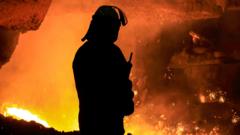
British Steel has officially been taken into public ownership, a move that the government believes will protect jobs and secure a “vital national capability.” This decision comes after years of operations in Scunthorpe, where the plant was still under the ownership of China’s Jingye Group, a fact that limited the government’s earlier announcements. Business Secretary Peter Kyle emphasized to the BBC that the government will need to cover the running costs “for the immediate future.” He also made it clear that the alternative—which would be letting the business go bust—is not an option.
Unite’s general secretary, Sharon Graham, welcomed the news of nationalization, stating that it was a necessary step. You see, blast furnaces are not just your ordinary machines; they’re designed to run continuously. If they cool down, it can lead to serious damage, and restarting them can require extensive work. The cost of even a planned refurbishment can reach tens of millions. The remaining furnaces at Scunthorpe are quite old; one, named Queen Anne, opened in 1954, while Queen Bess has been producing steel since 1938. Both are nearing the end of their operational lives, and restarting them after cooling would have been financially prohibitive for a company already drowning in red ink.
The government’s decision to keep Scunthorpe open is crucial because it’s the UK’s last remaining source of “virgin” steel. While the long-term strategy aims for all domestically produced steel to come from Electric Arc Furnaces (EAFs)—which are cheaper and more environmentally friendly—the government does not want to lose production at Scunthorpe just yet. The plant produces steel that is not manufactured anywhere else in the UK, which is essential for Network Rail and the construction industry. There was a palpable fear that losing this output would disrupt operations and make the country overly dependent on imports. So, the decision was made: keep Scunthorpe open until alternatives are available.
And let’s not forget the jobs at stake. Not only do people work directly for British Steel at Scunthorpe, but the plant also supports thousands more jobs in the supply chain. It serves as an economic anchor in North Lincolnshire, so shutting down the furnaces suddenly could have jeopardized many livelihoods. Simon Boyd, managing director of Reid Steel, a structural steel manufacturer based in Dorset, stated that the nationalization “had to be done.” He pointed out that Jingye had been “sabotaging the infrastructure” at the company, and the government “had to step in.” Now, British Steel belongs to the British people, not private companies.
This shift signals a new chapter for British Steel, as the UK government may block payouts to the owner and address the failures tied to Greybull, the previous owner. How will this play out in the coming months? Only time will tell…
Kaynak: Orijinal Haber
