
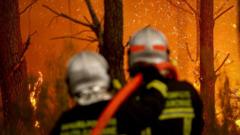
In a bold move to tackle the increasing menace of wildfires, especially in France’s Gironde region, technology is stepping up to the plate. Firefighters have long battled against the flames, but now, innovative tools and systems are transforming the way these blazes are detected and managed. The striking change? The traditional human lookouts, often students keeping watch, have been replaced by high-tech cameras and advanced monitoring systems that can detect fires from as far as 20 kilometers (12 miles) away. This is crucial because catching a fire early can mean the difference between a catastrophic disaster and a manageable situation.
The new system, implemented by a company named Midgard in Gironde, is part of a larger trend across France. Another start-up, FireTracking, is also making waves, having invested €1.2 million (about $1.4 million) to cover a vast area of 6,000 square kilometers (2,300 square miles). As soon as the system detects a fire, it notifies the firefighters immediately, and the clock starts ticking. FireTracking’s CEO, Jean-Simon Chaudier, emphasizes that every minute counts. “It could mean the difference between a catastrophe and a fire that can be limited to two or three hectares,” he explains, highlighting the urgency of early intervention.
But that’s not all. Technology is also bringing in the heavy artillery. Amphibious planes, which scoop water from rivers, lakes, and even the sea, are now a common sight. They dump this water onto the flames, forming the frontline of wildfire fighting both in France and worldwide. However, it’s not just about putting out fires; it’s about gathering critical information. Systems like SenForFire can measure gases released before flames are even visible. Yet, firefighter Guillaume Millet shares a reality check: “There’s no drone tech that’s reached that stage yet for firefighting.” While drones could enhance detection, they can’t replace the human element in firefighting operations.
And let’s talk about those Dash planes. They spray fire retardant ammonium phosphate, an orange powder that helps prevent vegetation from igniting too quickly. But again, they’re still in the early stages of implementation. The technology is aimed more at gathering vital information about the fire’s behavior—like smoke patterns, sudden weather changes, and the risk of collapsing trees—before the firefighters move in to tackle the flames directly. This shift could make their jobs safer, but according to Millet, replacing humans is still a long way off. “This has been the case since the creation of the first modern fire brigade in the Netherlands in the 1670s,” he notes, indicating that the human touch in firefighting is irreplaceable.
So, while it’s clear that technology is helping firefighters detect and respond to wildfires faster and more effectively, the sentiment remains that these brave individuals are irreplaceable. The equipment may evolve, but the heart of firefighting—human courage and instinct—will always be essential. As we look to the future, one can only wonder: how will these advancements shape the landscape of firefighting, and will there ever come a day when humans are no longer needed on the front lines?
Kaynak: Orijinal Haber