
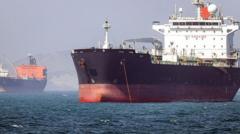
Oil prices fell to a three-week low on Tuesday, sending shockwaves through the market as senior US officials sparked renewed hopes for a deal with Iran to reopen the crucial Strait of Hormuz waterway. US Secretary of State Marco Rubio and Treasury Secretary Scott Bessent both chimed in, announcing that talks had made significant progress. They hinted that shipments could potentially resume as early as this week. The cost of a barrel of Brent crude, the global benchmark for oil prices, dropped nearly 5%, falling below $80 (£60). This drop comes as news surfaced that supply disruptions could finally be easing.
But let’s not forget, previous negotiations have crumbled over the past few months, leaving the oil market in a state of chaos. Drivers are feeling the pinch at the pump, with many already grappling with higher fuel prices. On the same day, West Texas Intermediate prices in the US also saw a decline of more than 5%, bringing the cost down to $76 a barrel. Both Brent and WTI contracts hit their lowest levels since July 13. Rubio mentioned some positive momentum in discussions aimed at allowing more ships to pass through the strait with the involvement of Iran and Oman. “They’re hoping that will happen very shortly. We might have a deal today or tomorrow to open the strait and move towards a more normalized position in this conflict,” he told CNBC.
Iran’s foreign ministry echoed these sentiments, stating that discussions with Oman – acting as a mediator – had been encouraging regarding a new protocol for vessels navigating through the Strait. Meanwhile, Qatar is still working behind the scenes, trying to facilitate a diplomatic resolution to the ongoing war. However, it admitted that no direct talks are currently on the table.
The Strait of Hormuz has been a hotbed of negotiations between the US and Iran, especially since the conflict erupted in late February. This strategic waterway used to handle about one-fifth of the world’s daily oil and liquefied natural gas supplies. But things changed dramatically when Iran halted most traffic through the strait, and the US responded with a naval blockade of Iranian ports. To add to the chaos, there’s also a blockade on Saudi Arabia’s ports in the Red Sea, as stated by Yemen’s shipping minister, though all 14 crew members on board have been rescued. Analysts are raising alarms, suggesting that the threat to oil-carrying ships in the Middle East is at its peak since the Iran war began.
“Investors are acutely aware of how many times we’ve seen these fluctuations,” said Danni Hewson, head of official analysis at AJ Bell. The ongoing disruptions have pushed prices up globally. In the UK, petrol prices have climbed back to levels seen at the conflict’s onset, with the average cost of a litre now hitting £1.60, according to the RAC motoring group. Over in the US, gasoline prices have crossed the $4 per gallon mark, with diesel nearing $5.40. Prices have skyrocketed to over $120 during intense escalations but have also seen dips following previous talks.
Despite the soaring revenues, major oil companies like BP, Shell, Chevron, and Exxon Mobil are seemingly caught in the crosshairs of the situation. Hewson remarked that these companies are “at the mercy” of US President Donald Trump’s political maneuvers. Just on Monday, Trump warned that Iran was facing its “last chance” for meaningful dialogues, hinting at massive strikes if negotiations don’t materialize.
In a twist, US stock markets were trading higher on Tuesday, buoyed by the optimism surrounding the negotiations that lowered oil prices, alongside positive corporate results related to Artificial Intelligence. Yet, investors have been jittery, with Wall Street responding to signals from Big Tech firms that spending on technology is set to keep climbing. So, the threat to oil tankers in the Middle East now appears to be worse than ever since the start of the Iran war. The significance of the Strait of Hormuz couldn’t be more pronounced during these turbulent times.
So, what’s next in this ongoing saga? We’ll have to keep our eyes peeled for further developments…
Kaynak: Orijinal Haber